
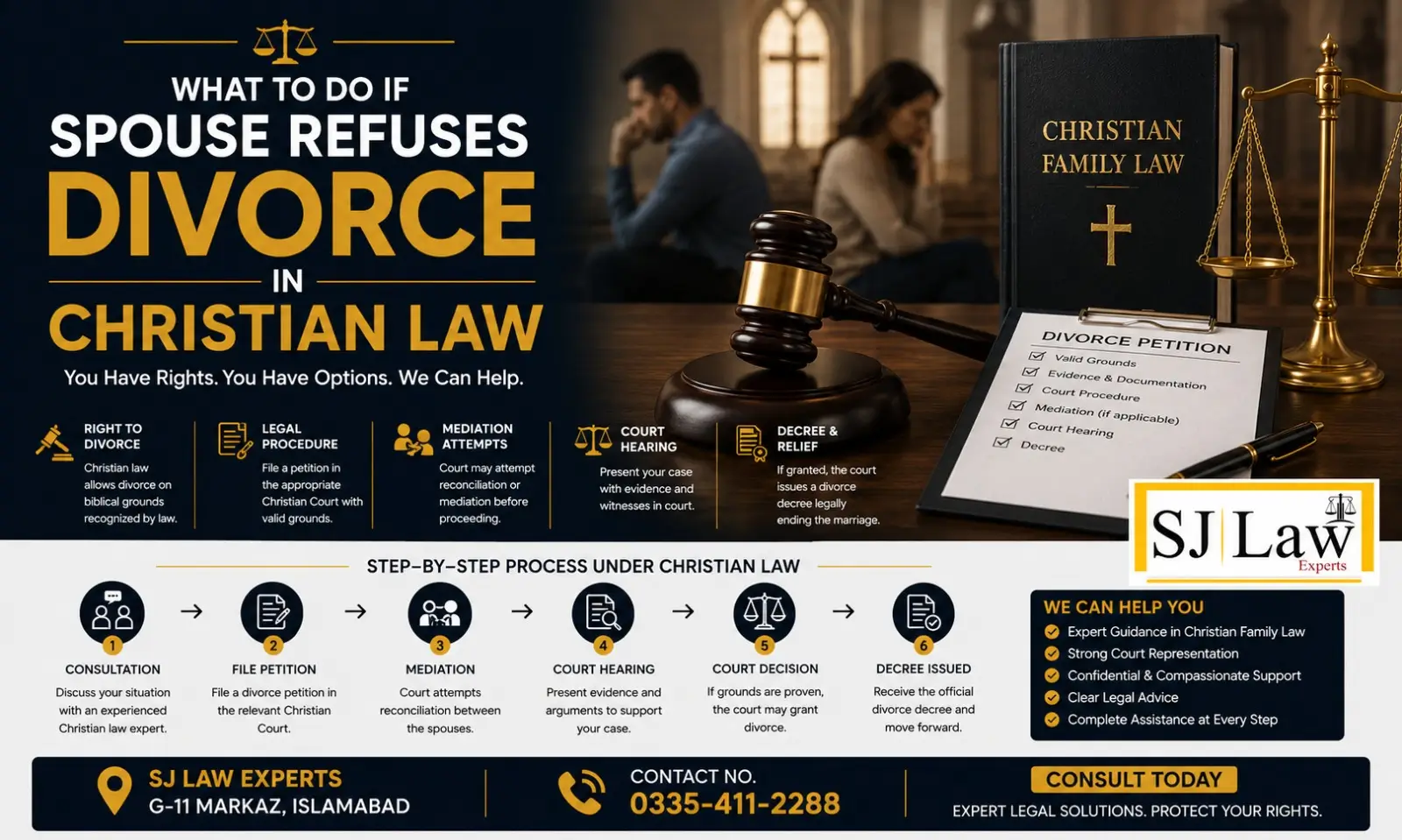
Marriage is a sacred bond in Christianity, but unfortunately, some marriages reach a point where continuing the relationship becomes impossible. In Pakistan, Christian couples may face additional challenges when one spouse wants to end the marriage while the other refuses to consent to the divorce. This situation often creates emotional stress, legal uncertainty, and confusion about available options. If your spouse refuses to agree to a divorce, it does not necessarily mean you are trapped in the marriage forever. Pakistani law provides legal mechanisms that allow individuals to seek divorce through the courts under certain circumstances. Understanding your rights and the legal process is essential when dealing with Christian Divorce Refusal Pakistan cases.
Understanding Christian Divorce Law in Pakistan
Christian marriages and divorces in Pakistan are governed by specific laws that regulate family matters for the Christian community. These laws provide legal grounds on which a spouse may seek dissolution of marriage through the Family Court. Unlike mutual divorce situations where both parties agree to separate, some cases become contested when one spouse opposes the divorce. In these situations, the court examines the facts, evidence, and legal grounds before making a decision. The refusal of one spouse does not automatically prevent the court from granting a divorce if sufficient legal grounds exist.
Can You Get a Divorce Without Your Spouse’s Consent?
Yes. A spouse’s refusal to agree does not necessarily stop divorce proceedings. If valid legal grounds are established, the court may grant a divorce even when the other spouse objects. This is commonly known as a Contested divorce Christian case. The court reviews the evidence presented by both parties and determines whether the marriage should legally end. The focus is not simply on whether one spouse agrees or disagrees but whether the legal requirements for divorce have been satisfied.
Common Grounds for Christian Divorce
When seeking divorce despite a spouse’s refusal, the petitioner must usually prove legally recognized grounds.
These may include:
- Cruelty or abusive behavior
- Adultery
- Desertion or abandonment
- Domestic violence
- Failure to fulfill marital obligations
- Irretrievable breakdown of marriage in applicable circumstances
The specific facts of each case play an important role in determining whether the court will grant relief.
What Happens When a Spouse Refuses Divorce?
When one spouse refuses to cooperate, the matter generally proceeds through formal court proceedings.
The process typically includes:
- Filing a Divorce Petition: The spouse seeking divorce files a petition before the Family Court outlining the legal grounds and supporting facts.
- Notice to the Other Spouse: The court issues notice to the respondent spouse, providing an opportunity to respond to the allegations.
- Evidence and Hearings: Both parties may present evidence, documents, and witness testimony supporting their positions.
- Court Decision: After reviewing the evidence, the court determines whether the legal requirements for divorce have been met. If sufficient grounds are proven, the court may grant a divorce despite the other spouse’s objections.
Importance of Evidence in Contested Cases
Evidence is often the deciding factor in Christian Divorce Refusal Pakistan matters.
Useful evidence may include:
- Medical records
- Police reports
- Witness statements
- Communication records
- Financial documents
- Photographs and other supporting materials
The stronger the evidence, the greater the likelihood of establishing the legal grounds necessary for divorce.
Challenges in Contested Divorce Cases
A Contested divorce Christian case can be more complex than a mutual divorce because both parties actively participate in the proceedings.
Common challenges include:
- Lengthy court proceedings
- Disputed facts
- Emotional stress
- Witness examinations
- Documentation requirements
Professional legal guidance can help manage these challenges and ensure compliance with court procedures.
Child Custody and Financial Matters
When children are involved, the court may also address issues relating to custody, visitation, maintenance, and welfare. The child’s best interests remain the primary consideration in custody-related decisions. Similarly, financial matters such as maintenance obligations may be considered separately from the divorce itself. Proper legal representation helps ensure that these important issues are addressed effectively.
How SJ Law Experts Helps
SJ Law Experts assists individuals facing Christian Divorce Refusal Pakistan cases by providing professional legal advice and representation. Their family law team helps clients prepare divorce petitions, gather evidence, navigate court procedures, and protect their rights throughout the legal process. Whether the matter involves a straightforward separation or a complex Contested divorce Christian case, SJ Law Experts works to achieve practical legal solutions while minimizing unnecessary delays and complications.
Why Legal Representation Matters
Contested divorce proceedings often involve technical legal requirements and procedural rules. Attempting to handle such cases without legal guidance can result in delays or missed opportunities to present important evidence.
An experienced family lawyer can:
- Assess the strength of your case
- Prepare legal documents
- Represent you in court
- Gather supporting evidence
- Protect your legal rights
- Develop an effective legal strategy
Professional representation often improves the efficiency and effectiveness of the proceedings.
Conclusion
Facing a situation where your spouse refuses to agree to a divorce can be frustrating and emotionally challenging. However, Pakistani law does not automatically prevent divorce simply because one spouse objects. If valid legal grounds exist, the Family Court has the authority to examine the evidence and make a decision based on the law. Understanding your rights, gathering strong evidence, and obtaining professional legal assistance are important steps when dealing with Christian Divorce Refusal Pakistan matters. With proper preparation and legal support, individuals can pursue a lawful resolution even in complex Contested divorce Christian cases.
Can I get a Christian divorce if my spouse refuses?
Yes. The court may grant a divorce if legally recognized grounds are proven, even if the other spouse objects.
What is a contested Christian divorce?
A contested divorce occurs when one spouse seeks divorce and the other spouse opposes it.
How long does a contested divorce take?
The duration varies depending on the complexity of the case, evidence, and court proceedings.
What evidence is useful in a contested divorce case?
Medical records, witness testimony, communication records, police reports, and other relevant documents may help support the case.
Should I hire a lawyer for a contested divorce?
Yes. Legal representation can help protect your rights and improve the presentation of your case before the court.
