A single mistake in your I-130 petition can add months to your family’s separation. Understanding the correct filing process, documentation requirements, and common USCIS concerns can help you avoid delays and improve your chances of approval.For many Pakistani families, reunification with a spouse living in the United States is a life-changing goal. The first and most important step in this journey is filing Form I-130, Petition for Alien Relative, with the United States Citizenship and Immigration Services (USCIS). This petition establishes the qualifying family relationship and serves as the foundation for obtaining an immigrant visa.
Although the process appears straightforward, many applicants face delays, Requests for Evidence (RFEs), or even denials due to incomplete documentation, errors in forms, or insufficient proof of a genuine marital relationship. Filing a successful I130 Spouse Visa USA Pakistan petition requires careful preparation, accurate information, and compliance with USCIS requirements.
Understanding the USCIS I-130 Petition
The I-130 Petition for Alien Relatives is used by U.S. citizens and lawful permanent residents to establish a qualifying family relationship with an eligible relative. For married couples, the petition confirms that a valid marital relationship exists between the petitioner and beneficiary. Approval of Form I-130 does not automatically grant a visa. Instead, it allows the case to move to the next stage of the immigration process, including National Visa Center (NVC) processing and immigrant visa interviews. For applicants pursuing an I130 Spouse Visa USA Pakistan, the quality and accuracy of the petition play a critical role in determining how efficiently the case progresses through the immigration system.
Who Can File an I-130 Petition?
The following individuals may generally file Form I-130 for a spouse:
- U.S. citizens.
- Lawful permanent residents (Green Card holders).
The petitioner must prove both their immigration status and the existence of a legally valid marriage. USCIS carefully reviews these factors before approving the petition. If the marriage occurred in Pakistan, applicants should ensure that all marriage documents are legally recognized and properly translated when necessary.
Documents Required for I130 Spouse Visa USA Pakistan
Proper documentation is one of the most important factors in obtaining approval. Missing or inconsistent documents frequently result in delays and Requests for Evidence.
Proof of Petitioner Status
The petitioner must provide evidence of U.S. citizenship or lawful permanent residence. Common documents include:
- U.S. passport.
- Certificate of Naturalization.
- Certificate of Citizenship.
- Permanent Resident Card (Green Card).
Marriage Documentation
Applicants must provide evidence that the marriage is legally valid. Typical documents include:
- Marriage certificate (Nikah Nama).
- NADRA Marriage Registration Certificate.
- Certified English translations where required.
Evidence of a Genuine Marriage
USCIS carefully examines whether the marriage is bona fide and not entered into solely for immigration purposes.
Useful supporting evidence may include:
- Wedding photographs.
- Family photographs.
- Communication records.
- Travel records.
- Joint financial documents.
- Correspondence between spouses.
- Affidavits from family members and friends.
Strong evidence of a genuine relationship can significantly strengthen an I130 Spouse Visa USA Pakistan application.
Common Reasons USCIS I-130 Petitions Face Delays
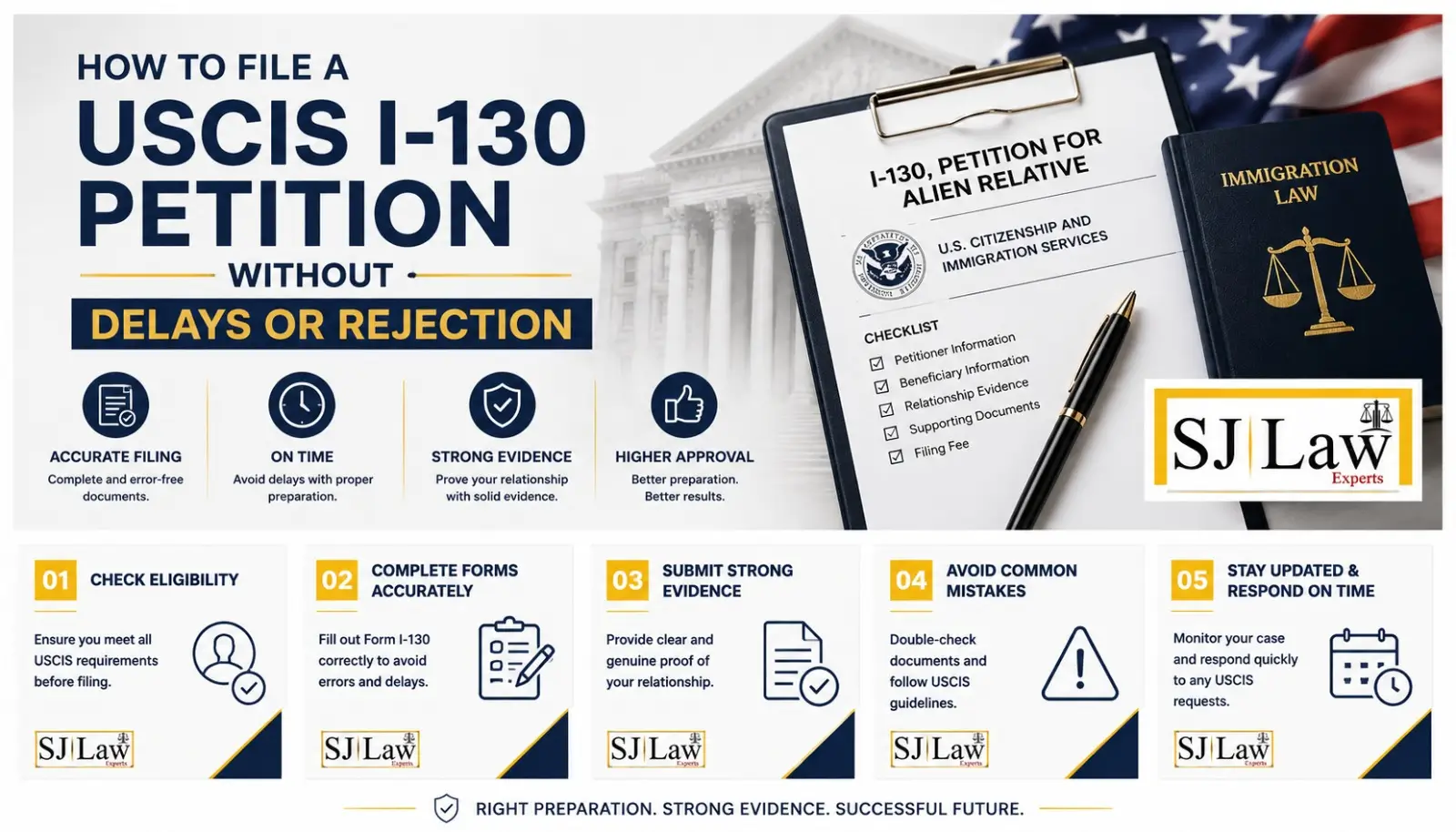
- Incomplete Forms: Even minor mistakes can result in processing delays. Missing signatures, unanswered questions, and inaccurate information often trigger additional review. Applicants should carefully review every section before submission.
- Insufficient Relationship Evidence: One of the most common issues in US family immigration Pakistan cases involves inadequate proof of a genuine marital relationship. Submitting only a marriage certificate may not be enough. USCIS typically expects evidence demonstrating an ongoing relationship.
- Inconsistent Information: Information provided in the petition should match all supporting documents. Differences in names, dates, addresses, or family details may raise concerns and lead to requests for clarification.
- Missing Translations: Any document not in English generally requires a certified English translation. Failure to provide translations can delay processing and create avoidable complications.
How to Avoid an RFE (Request for Evidence)
Receiving an RFE does not necessarily mean your case will be denied, but it often extends processing times.
To reduce the likelihood of an RFE:
- Submit complete documentation initially.
- Include extensive relationship evidence.
- Verify consistency across all documents.
- Ensure all forms are signed.
- Provide certified translations where necessary.
- Double-check filing fees and requirements.
A well-prepared petition helps USCIS make a decision without requesting additional information.
USCIS Review Process for Pakistani Spouse Petitions
After receiving the petition, USCIS reviews the application and supporting evidence. Officers assess whether:
- The petitioner is eligible to file.
- The marriage is legally valid.
- The relationship is genuine.
- All required documents have been provided.
If satisfied, USCIS approves the petition and forwards the case for immigrant visa processing. If concerns exist, USCIS may issue an RFE or, in some cases, deny the petition. Understanding how officers evaluate USCIS I-130 Petition Pakistan cases helps applicants prepare stronger submissions.
The Importance of Relationship Evidence
Relationship evidence is often the deciding factor in spouse-based immigration cases. USCIS wants to see that the marriage represents a genuine relationship rather than an arrangement entered into solely for immigration benefits. Applicants should submit evidence covering different stages of the relationship, including:
- Courtship.
- Engagement.
- Marriage ceremony.
- Ongoing communication.
- Future plans together.
The more comprehensive the evidence, the easier it becomes for USCIS to understand the authenticity of the marriage.
Common Mistakes Pakistani Applicants Should Avoid
Many delays and denials occur because applicants make preventable errors.
These include:
- Filing incomplete forms.
- Providing insufficient marital evidence.
- Using inconsistent information.
- Failing to disclose previous marriages.
- Submitting unclear document copies.
- Ignoring translation requirements.
- Failing to respond promptly to RFEs.
Avoiding these mistakes can save months of processing time.
How SJ Law Experts Helps
At SJ Law Experts, we assist families with every stage of the I130 Spouse Visa USA Pakistan process. Our legal team carefully reviews documentation, prepares petitions, identifies potential weaknesses, and ensures compliance with USCIS requirements. We help clients gather persuasive relationship evidence, address complex immigration issues, respond to Requests for Evidence, and prepare complete petition packages designed to minimize delays and reduce the risk of rejection. Whether you are filing a new USCIS I-130 Petition Pakistan or seeking guidance on a pending case, SJ Law Experts provides professional legal support tailored to your family’s immigration goals.
Tips for a Successful Petition
A successful I-130 petition often depends on preparation and attention to detail.
Key recommendations include:
- Submit complete and accurate forms.
- Organize supporting documents professionally.
- Provide extensive relationship evidence.
- Ensure consistency across all records.
- Respond quickly to USCIS requests.
- Seek legal guidance when necessary.
These steps can help create a stronger case and improve processing efficiency.
Conclusion
Filing an I130 Spouse Visa USA Pakistan petition is a critical step toward family reunification in the United States. While the process can be complex, careful preparation and thorough documentation can significantly reduce the risk of delays, RFEs, and denials. By understanding USCIS requirements, providing strong evidence of a genuine marriage, and avoiding common mistakes, applicants can improve their chances of a successful outcome. For families pursuing US family immigration Pakistan, professional legal guidance can provide valuable support throughout the process and help ensure that every aspect of the petition is handled correctly.
What is Form I-130?
Form I-130 is a petition used to establish a qualifying family relationship for immigration purposes.
Who can file an I-130 for a spouse?
U.S. citizens and lawful permanent residents may generally file for their spouse.
What documents are needed for an I-130 spouse petition?
Marriage certificates, proof of petitioner status, relationship evidence, and identification documents are commonly required.
Can USCIS issue an RFE for an I-130 petition?
Yes, USCIS may request additional information if documentation is incomplete or insufficient.
How can I avoid delays in my I-130 petition?
Submit complete forms, provide strong relationship evidence, and ensure all documents are accurate and consistent.