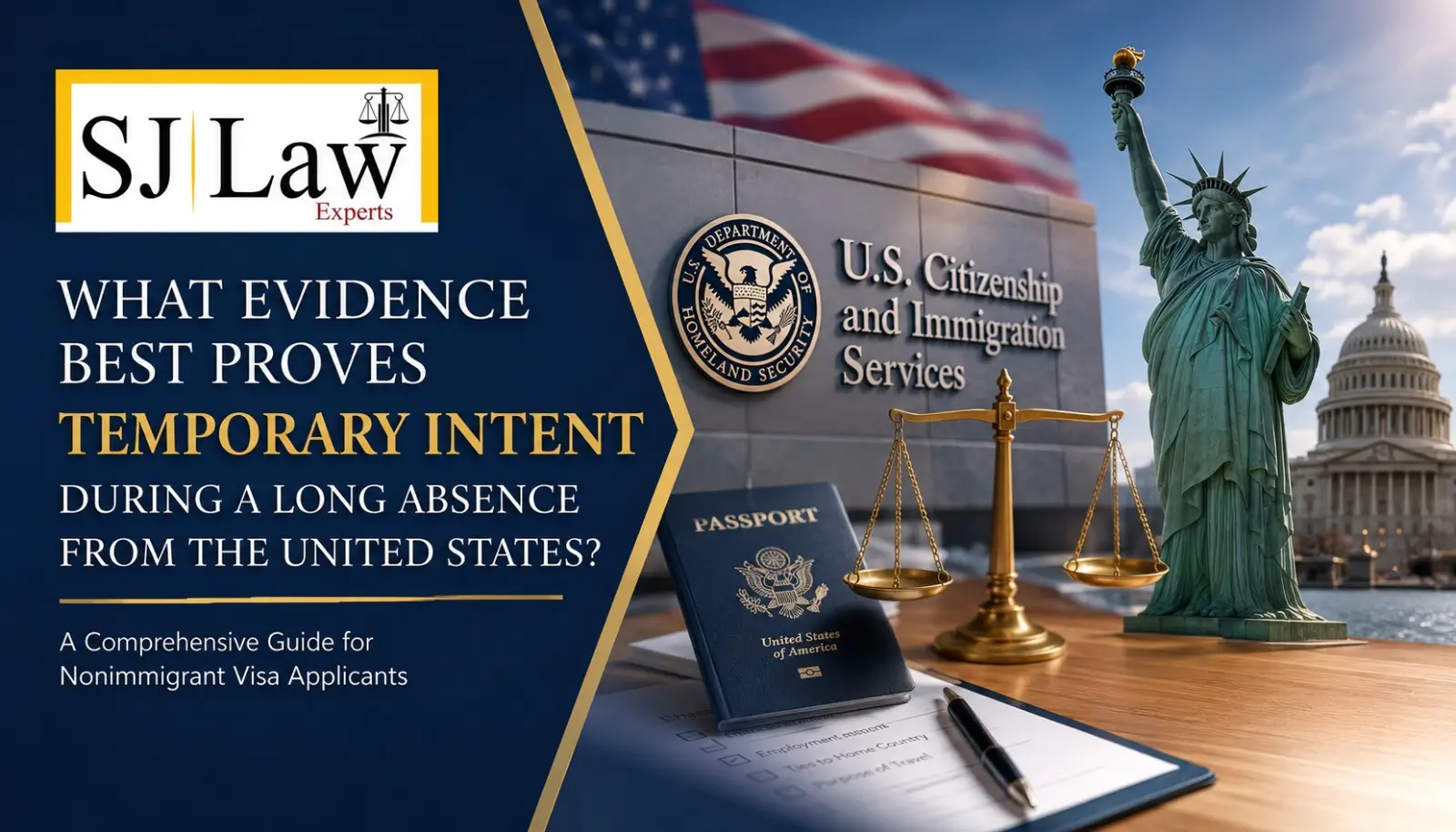
If you’ve been outside the United States for several months or even more than a year, returning isn’t always as simple as booking a flight. Whether you’re a lawful permanent resident (Green Card holder), applying for U.S. citizenship, or seeking a returning resident visa, immigration officers may ask an important question:
“Did you intend to maintain your residence in the United States, or did you abandon it?”
The answer depends on the evidence you provide.
A long absence doesn’t automatically mean you’ve given up your U.S. residency. Many people stay abroad longer than expected because of medical emergencies, family obligations, overseas work assignments, travel restrictions, or unforeseen personal circumstances. What matters is whether you can prove that your absence was temporary and that you always intended to return to the United States.
Quick Answer (Featured Snippet)
The best evidence to prove temporary intent after a long absence from the United States includes maintaining U.S. employment, filing U.S. resident tax returns, keeping a home or lease in the U.S., maintaining active U.S. bank accounts, having immediate family in the United States, and documenting the reason for your extended stay abroad. Immigration officers evaluate the totality of your circumstances rather than relying on a single document.
What Does “Temporary Intent” Mean?
Temporary intent means that although you stayed outside the United States for an extended period, you never intended to permanently abandon your U.S. residence. Simply put, your trip abroad had a beginning, a purpose, and an intention to return. Immigration officers don’t expect life to go exactly as planned. They understand that unexpected events, such as illness, employment changes, family emergencies, or international travel disruptions, can delay your return. However, they expect you to show that your primary home and long-term ties remained connected to the United States throughout your absence.
Think of temporary intent as answering one simple question:
“If your circumstances had not changed, would you have returned to the United States as originally planned?”
If the answer is yes, your supporting documents should clearly demonstrate that intention.
Why Does USCIS Question Long Absences?
Many people believe that spending more than six months outside the United States automatically results in losing their Green Card. This is a common misconception. The truth is more nuanced. A lengthy absence doesn’t automatically terminate your permanent resident status. Instead, it raises questions about whether you intended to continue living permanently in the United States.
Immigration officers may examine factors such as:
- The reason for your absence
- Whether your absence was planned or unexpected
- Whether you maintained employment in the United States
- Whether you continued filing U.S. taxes
- Whether you kept a residence in the United States
- Whether your immediate family remained in the country
- Whether you established permanent ties in another country
The stronger your evidence, the easier it becomes to demonstrate that your absence was temporary rather than permanent.
Understanding the Three Important Travel Rules
The length of your absence plays an important role in how immigration authorities evaluate your case.
Absence of Less Than 6 Months
Generally, trips lasting fewer than six months do not create significant concerns. Most lawful permanent residents can return without needing to prove that they maintained continuous residence, although immigration officers still have the authority to ask questions if necessary.
Absence Between 6 and 12 Months
This is where many applicants encounter additional scrutiny. A trip lasting between six and twelve months may create a presumption that your continuous residence was interrupted for naturalization purposes. However, this presumption can often be overcome by presenting strong evidence that you maintained substantial ties to the United States.
Examples include:
- Continuous U.S. employment
- Immediate family remaining in the United States
- Active U.S. bank accounts
- Ongoing mortgage or rental payments
- Filing U.S. resident tax returns
The goal is to show that your primary residence remained in the United States despite your temporary stay abroad.
Absence of More Than 12 Months
An absence exceeding one year generally carries greater immigration consequences. Without proper planning, such as obtaining a Re-entry Permit before departure or qualifying for other exceptions, you may face challenges demonstrating that you did not abandon your lawful permanent resident status. If your prolonged stay occurred due to circumstances beyond your control, you may need to explore options such as an SB-1 Returning Resident Visa. Many applicants in this situation choose to consult an experienced SB-1 Visa Lawyer Pakistan or SB1 visa expert to evaluate their eligibility and prepare the strongest possible case.
The 15 Strongest Types of Evidence That Prove Temporary Intent
One of the biggest misconceptions among Green Card holders is that one document is enough to prove temporary intent. In reality, USCIS and Customs and Border Protection (CBP) evaluate the totality of your circumstances. This means they consider all the evidence together before deciding whether you maintained your U.S. residence during your absence. The stronger and more consistent your documentation, the easier it is for an immigration officer to conclude that your stay abroad was only temporary. Below are the most persuasive types of evidence, ranked by their importance.
1. Proof of Continuous U.S. Employment (Strongest Evidence)
If you remained employed by a U.S. company while abroad, this is often one of the most convincing pieces of evidence. An employment relationship shows that your professional life continued to be centered in the United States rather than another country.
Useful documents include:
- Employment verification letter
- Recent pay stubs
- W-2 forms
- Employment contract
- Remote work authorization
- Employer letter explaining your overseas assignment
Expert Tip: Ask your employer to clearly state that your overseas stay was temporary and that your employment continued throughout your absence.
2. Filing U.S. Resident Tax Returns
Many applicants overlook tax records, but immigration officers place significant weight on them. Filing taxes as a U.S. resident demonstrates that you continued to consider the United States your permanent home.
Helpful documents include:
- IRS tax transcripts
- Form 1040
- State tax returns
- Proof of tax payments
Avoid This Mistake: Never file as a nonresident unless advised by a qualified tax professional, as it may suggest that you no longer consider the United States your primary residence.
3. Maintaining a Home in the United States
Your residence says a lot about where your permanent home is. Whether you own or rent, maintaining your home during your absence helps demonstrate that you intended to return.
Examples include:
- Mortgage statements
- Lease agreements
- Property tax receipts
- Homeowners insurance
- Utility bills
If your home remained available during your absence, mention this in your explanation letter.
4. Immediate Family Remaining in the United States
Family ties are another strong indicator of temporary intent. If your spouse or children continued living in the United States while you were abroad, immigration officers may view this as evidence that your primary residence remained in America.
Supporting documents include:
- Marriage certificate
- Children’s school records
- Utility bills
- Family health insurance
- Birth certificates
5. Active U.S. Bank Accounts
Keeping your financial life active in the United States shows ongoing economic ties.
Examples include:
- Monthly bank statements
- Savings account records
- Credit card statements
- Automatic bill payments
Regular transactions strengthen your case far more than inactive accounts.
6. Valid U.S. Driver’s License
Although it isn’t the strongest evidence on its own, a valid driver’s license supports your overall case.
Include:
- Driver’s license copy
- Renewal records
- Vehicle registration
- Auto insurance
7. Business Ownership
If you own a company in the United States, provide documents showing that your business continued operating while you were abroad.
Useful records include:
- Business registration
- Annual reports
- Payroll records
- Tax filings
- Client contracts
Business ownership demonstrates continuing economic ties to the United States.
8. Medical Emergencies
Unexpected medical situations frequently explain prolonged absences. However, simply stating that someone was sick is not enough.
Support your explanation with:
- Hospital records
- Medical reports
- Doctor’s letters
- Treatment timeline
- Prescription records
The more detailed the documentation, the more credible your explanation becomes.
9. Temporary Overseas Employment
Many multinational companies assign employees overseas for limited periods.
In these cases, provide:
- Assignment letter
- HR confirmation
- Return-to-work notice
- Payroll records
- Employment continuation letter
These documents show that your overseas stay was part of a temporary work assignment rather than permanent relocation.
10. Educational Commitments
If you remained abroad to complete an educational program, provide evidence showing that your studies had a defined end date.
Helpful documents include:
- University enrollment letters
- Academic transcripts
- Graduation confirmation
- Tuition payment receipts
- Student identification
11. Evidence That You Never Established Permanent Ties Abroad
Immigration officers don’t only evaluate your U.S. ties, they also examine whether you created permanent ties in another country.
Evidence that supports your case includes:
- No foreign employment
- No permanent residence abroad
- No foreign mortgage
- No long-term property ownership
- No foreign tax residency
Showing that you did not settle permanently overseas can strengthen your application.
12. Travel History
A well-documented travel history helps explain your movements.
Include:
- Passport stamps
- Airline tickets
- Boarding passes
- Immigration records
- Travel itineraries
If your return was delayed because of canceled flights, travel restrictions, or emergencies, include evidence supporting those circumstances.
13. Community Connections
Community involvement may not carry the same weight as employment or taxes, but it reinforces your overall ties to the United States.
Examples include:
- Church membership
- Professional associations
- Volunteer organizations
- Gym memberships
- Local club memberships
These documents help demonstrate that your personal life remained rooted in the United States.
14. Affidavits Supporting Your Case
Affidavits can strengthen your application when supported by documentary evidence.
People who may provide affidavits include:
- Employers
- Family members
- Business partners
- Attorneys
- Community leaders
These statements should explain why your absence was temporary and confirm your intention to return.
15. A Well-Written Personal Explanation Letter
This is one of the most overlooked pieces of evidence. A thoughtful explanation letter helps immigration officers understand your situation before reviewing your documents.
Your letter should answer five important questions:
- Why did you leave the United States?
- Why did your absence become longer than expected?
- What ties did you maintain?
- Why did you never intend to abandon your U.S. residence?
- What evidence supports your explanation?
Keep the letter honest, organized, and easy to follow.
Evidence Strength Comparison Table
| Evidence | Strength | Why It Matters |
| U.S. Employment | ⭐⭐⭐⭐⭐ | Shows continued professional ties |
| Resident Tax Returns | ⭐⭐⭐⭐⭐ | Demonstrates U.S. residency for tax purposes |
| Immediate Family in U.S. | ⭐⭐⭐⭐☆ | Indicates ongoing personal ties |
| Home Ownership or Lease | ⭐⭐⭐⭐☆ | Shows permanent residence remained available |
| Business Ownership | ⭐⭐⭐⭐☆ | Establishes long-term economic connections |
| Bank Accounts | ⭐⭐⭐⭐☆ | Reflects active financial activity |
| Medical Records | ⭐⭐⭐⭐☆ | Explains unavoidable delays |
| Driver’s License | ⭐⭐⭐☆☆ | Supports overall residency |
| Community Memberships | ⭐⭐⭐☆☆ | Reinforces personal ties |
| Affidavits | ⭐⭐⭐☆☆ | Strengthens supporting evidence |
Common Reasons USCIS Believes You Abandoned Your U.S. Residence (Even If You Didn’t)
Many lawful permanent residents assume that keeping a valid Green Card is enough to protect their immigration status. Unfortunately, that’s not always the case. USCIS and U.S. Customs and Border Protection (CBP) don’t base their decisions on one document alone, they examine your actions, travel history, and overall circumstances to determine whether you intended to maintain your U.S. residence. Even if you never planned to give up your Green Card, certain actions may create the impression that you abandoned your permanent residence. Understanding these red flags can help you prepare stronger evidence and avoid unnecessary complications.
1. Staying Outside the United States for Too Long
The longer you remain outside the United States, the more likely immigration officers are to ask additional questions. While there is no rule stating that every long trip results in losing your Green Card, extended absences naturally raise concerns about where your permanent home is located.
Key Takeaway: If your stay abroad becomes longer than expected, begin collecting supporting documents immediately rather than waiting until you return.
2. Accepting Permanent Employment Abroad
Working overseas doesn’t automatically mean you’ve abandoned your U.S. residence. However, accepting permanent employment with no clear plan to return can weaken your case.
Immigration officers may ask questions such as:
- Was your overseas position temporary or permanent?
- Did you resign from your U.S. employer?
- Did you move your career permanently to another country?
- Did you maintain professional ties in the United States?
3. Buying a Permanent Home in Another Country
Purchasing a home abroad isn’t automatically a problem, but it can become one if it appears you’ve relocated permanently. Immigration officers compare your foreign ties with your U.S. ties.
Questions they may consider include:
- Did you sell your U.S. home?
- Did you terminate your lease?
- Did you purchase a permanent residence overseas?
- Where do you spend most of your time?
If you maintained your U.S. residence while temporarily living abroad, be prepared to provide supporting evidence.
4. Failing to File U.S. Resident Tax Returns
Your tax filings can significantly influence how immigration officers view your case. If you stopped filing U.S. resident tax returns or filed as a nonresident without a valid reason, officers may question whether you considered the United States your permanent home.
Keep copies of:
- Federal tax returns
- IRS transcripts
- State tax returns (if applicable)
- Tax payment records
Consistent tax compliance strengthens your credibility.
5. Moving Your Immediate Family Overseas
Family relationships are among the strongest indicators of where someone truly lives. If your spouse and children permanently relocate outside the United States, officers may question whether your primary residence also moved abroad. On the other hand, if your immediate family remained in the United States while you were temporarily away, this often supports your claim that you intended to return.
6. Closing Your U.S. Bank Accounts
Many applicants overlook financial records. Closing your bank accounts, canceling your credit cards, or transferring all your finances overseas may suggest that you no longer planned to live in the United States.
Instead, continue maintaining:
- Active checking accounts
- Savings accounts
- Credit cards
- Automatic bill payments
These records demonstrate ongoing financial ties.
7. Giving Up Your U.S. Driver’s License
Although a driver’s license alone won’t prove temporary intent, surrendering it while obtaining permanent identification in another country may weaken your overall case. Maintaining a valid driver’s license, vehicle registration, and insurance can help reinforce your connection to the United States.
8. Poor Documentation During Your Absence
One of the most common mistakes is assuming you’ll remember everything later. Months or years after returning, applicants often struggle to locate:
- Flight confirmations
- Hospital records
- Employment letters
- Rental agreements
- Utility bills
Without documentation, even truthful explanations become harder to verify.
Best Practice: Create a digital folder containing all important documents related to your trip as soon as your absence begins.
Warning Signs Immigration Officers Look For
Immigration officers evaluate patterns, not isolated events. The following factors may prompt additional questions during your interview or inspection at the port of entry.
| Potential Red Flag | Why It May Raise Concern |
| Long absence with no explanation | Suggests possible abandonment of residence |
| Permanent overseas employment | Indicates stronger ties abroad |
| Selling your U.S. home | May suggest relocation |
| Filing taxes as a nonresident | Could contradict your claim of U.S. residency |
| Immediate family relocating overseas | Weakens evidence of continuing U.S. residence |
| Closing U.S. financial accounts | Reduces evidence of ongoing financial ties |
| Purchasing permanent property abroad | May indicate plans to settle outside the U.S. |
Remember, one red flag does not automatically result in losing your status. Immigration officers assess your case based on the totality of the evidence.
What Immigration Officers Want to See
Think about your case from the officer’s perspective. Their goal is to determine whether your absence was genuinely temporary. The strongest cases usually answer these four questions clearly:
- Did you have a legitimate reason for staying abroad?: Medical emergencies, temporary work assignments, family responsibilities, or travel restrictions are examples of circumstances that may explain an extended absence.
- Did you maintain meaningful ties to the United States?: Strong evidence includes employment, housing, financial accounts, tax filings, and family connections.
- Did you avoid establishing permanent ties in another country?: The less evidence there is that you settled abroad permanently, the stronger your case becomes.
- Is your explanation consistent with your documents?: Every statement should match the evidence you provide. Consistency builds trust and credibility.
Step-by-Step Checklist to Prove Temporary Intent After a Long Absence From the United States
Proving temporary intent isn’t about submitting one perfect document, it’s about building a complete and consistent picture of your life before, during, and after your absence. Immigration officers look for evidence that shows you always intended to return to the United States and that your extended stay abroad resulted from temporary circumstances rather than a decision to relocate permanently. The following checklist will help you organize your documents and strengthen your case before attending an immigration interview or returning to the United States.
Step 1: Explain Why You Stayed Outside the United States
Start by clearly identifying the reason for your prolonged absence. Your explanation should be factual, concise, and supported by documentation.
Common reasons include:
- Medical treatment or recovery
- Caring for a seriously ill family member
- Temporary overseas employment
- Educational commitments
- Travel restrictions or flight cancellations
- Natural disasters
- Family emergencies
- Military or government assignments
Pro Tip
Avoid vague explanations like “I stayed longer than expected.” Instead, explain what happened, when it happened, and why it delayed your return.
Step 2: Gather Proof of Your U.S. Employment
Employment is often one of the strongest indicators that your primary life remains in the United States.
- Collect documents such as:
- Employment verification letter
- Recent pay stubs
- W-2 forms
- Employment contract
- HR confirmation of continued employment
- Remote work authorization (if applicable)
If your employer temporarily transferred you overseas, request a letter confirming that the assignment was temporary and that your position in the United States remained active.
Step 3: Show That You Maintained a Home in the United States
Keeping your residence demonstrates that you always planned to return.
Useful documents include:
- Mortgage statements
- Lease agreement
- Property tax receipts
- Home insurance policy
- HOA payment records
If you stayed with relatives abroad while keeping your U.S. residence, explain this clearly in your personal statement.
Step 4: Demonstrate Strong Financial Ties
Your financial records can reinforce your claim that your economic life remained centered in the United States.
Include:
- Checking account statements
- Savings account records
- Credit card statements
- Investment account statements
- Retirement account records
- Automatic bill payments
Immigration officers generally view active financial accounts more favorably than dormant ones.
Step 5: Include Your U.S. Tax Records
Tax compliance is one of the most persuasive forms of evidence.
Prepare copies of:
- Federal tax returns
- IRS Tax Transcripts
- State tax returns (if applicable)
- Proof of tax payments
Always ensure that your tax filings are consistent with your explanation of temporary intent.
Step 6: Prove Your Family Connections
Family relationships often demonstrate where your permanent home truly is.
Supporting documents may include:
- marriage certificate
- Children’s birth certificates
- School enrollment records
- Family medical insurance
- Proof that your spouse remained in the United States
If your family accompanied you abroad, explain why and provide additional evidence showing your continued intention to return.
Step 7: Document the Reason for Your Delay
Every explanation should be supported by evidence.
Medical Emergency
Provide:
- Hospital records
- Medical reports
- Doctor’s letters
- Treatment timeline
Temporary Employment
Provide:
- Assignment letter
- Employer confirmation
- Return schedule
Education
Provide:
- Enrollment verification
- Graduation certificate
- Academic transcript
Travel Restrictions
Provide:
- Airline cancellation notices
- Government travel advisories
- Border closure announcements
The more objective evidence you provide, the stronger your explanation becomes.
Step 8: Prepare a Personal Statement
Your personal statement connects all of your documents into one clear story.
Your letter should answer:
- Why did you leave the United States?
- Why did your trip become longer than planned?
- What ties did you maintain in the United States?
- Why did you never intend to abandon your residence?
- When and why did you return?
Write honestly and avoid emotional exaggeration. A clear, factual explanation is more persuasive than lengthy or overly dramatic language.
Step 9: Organize Your Documents Professionally
A well-organized application makes it easier for immigration officers to review your evidence.
Consider arranging your documents in this order:
- Cover Letter
- Personal Statement
- Identity Documents
- Employment Records
- Tax Returns
- Property Documents
- Financial Records
- Family Documents
- Medical or Supporting Evidence
- Travel Records
Using labeled sections or dividers can make your application easier to follow.
Step 10: Review Everything Before Your Interview
Before attending your interview or arriving at a U.S. port of entry, review every document carefully.
Ask yourself:
- Are all dates accurate?
- Does every statement match my supporting documents?
- Can I clearly explain my absence?
- Do I have evidence for every important claim?
If possible, conduct a mock interview with an immigration professional or trusted advisor to build confidence.
Mistakes to Avoid While Preparing Your Evidence
Even applicants with valid reasons for a long absence can weaken their case by making avoidable mistakes.
Avoid these common errors:
- Submitting incomplete documentation
- Providing inconsistent travel dates
- Forgetting to include tax records
- Relying only on verbal explanations
- Submitting poor-quality document copies
- Waiting until the last minute to gather evidence
- Omitting important supporting records
Remember, immigration officers appreciate applications that are organized, complete, and easy to understand.
When Should You Seek Professional Immigration Guidance?
If your absence exceeded one year, involved multiple extended trips, or includes unusual circumstances, professional legal advice may be beneficial. An experienced Immigration lawyer Islamabad USA visa professional can review your evidence, identify potential weaknesses, and help you present your case effectively.
Applicants pursuing a Returning Resident Visa may also benefit from working with an experienced SB-1 Visa Lawyer Pakistan or SB1 visa expert. Reliable US immigration help can improve your preparation, reduce avoidable mistakes, and ensure your documentation aligns with current immigration requirements.
How to Prepare for Your USCIS or CBP Interview: Common Questions and Sample Answers
If you’ve been outside the United States for an extended period, don’t be surprised if a USCIS officer or a U.S. Customs and Border Protection (CBP) officer asks additional questions about your trip. These questions are not meant to intimidate you, they are intended to help officers determine whether you maintained your lawful permanent resident status and whether your absence was genuinely temporary. The key to a successful interview is simple: be honest, stay consistent, and support your answers with documentation.
Common Interview Questions
Why were you outside the United States for so long?
Explain the exact reason for your extended stay and avoid vague answers.
Good Answer:
“I traveled to Pakistan to care for my father after major surgery. His recovery took much longer than expected, so I remained there until he was medically stable. Throughout my absence, I continued filing my U.S. tax returns, maintained my U.S. bank accounts, and kept my apartment in the United States.”
Did you intend to live permanently outside the United States?
Your answer should clearly state that your trip was always temporary.
Good Answer:
“No. My intention was always to return to the United States. My stay abroad was temporary, and I maintained my employment, financial accounts, and other important ties in the United States during my absence.”
Did you work while you were abroad?
Answer truthfully and explain whether your work was temporary or connected to your U.S. employer. If you continue working remotely for a U.S. company, provide supporting documentation such as employer letters and pay records.
Do you still have ties to the United States?
This is your opportunity to highlight your strongest evidence.
Mention:
- Employment
- Property ownership
- Lease agreement
- Immediate family
- Tax filings
- Bank accounts
- Business interests
- Community involvement
Always support your statements with documents whenever possible.
Interview Tips That Can Improve Your Case
Keep these practical tips in mind before your interview:
- Review your travel history and important dates.
- Organize your documents in logical order.
- Answer only the question that is asked.
- Avoid guessing if you are unsure about a date or detail.
- Never submit altered or misleading documents.
- Stay calm and respectful throughout the interview.
Immigration officers appreciate applicants who are prepared, organized, and honest.
Final Thoughts
Proving temporary intent after a long absence from the United States is about demonstrating that your stay abroad was temporary, not permanent. Strong evidence such as U.S. employment, tax returns, financial records, family ties, and a clear explanation can significantly strengthen your case. If your situation is complex, seeking guidance from an experienced Immigration lawyer Islamabad USA visa professional, SB-1 Visa Lawyer Pakistan, or SB1 visa expert can help you prepare the right documentation and avoid common mistakes. With careful preparation and reliable US immigration help, you can confidently present your case and protect your immigration status.
1. What is the strongest evidence of temporary intent?
The strongest evidence includes continued U.S. employment, resident tax returns, maintaining a home in the United States, active financial accounts, and immediate family ties.
2. Can I lose my Green Card after staying outside the United States for one year?
A long absence may lead immigration officers to question whether you abandoned your permanent residence. Your eligibility depends on your individual circumstances and the evidence you provide.
3. Does filing U.S. taxes help prove temporary intent?
Yes. Filing U.S. resident tax returns is one of the strongest indicators that you continued to consider the United States your permanent home.
4. Is a Re-entry Permit required for every long trip?
Not always. However, lawful permanent residents planning to remain outside the United States for an extended period should determine whether a Re-entry Permit is appropriate for their situation before departure.
5. Can medical emergencies justify a prolonged absence?
Yes. Medical emergencies can be accepted when supported by hospital records, physician letters, and other credible documentation.
6. What if I worked overseas during my absence?
Temporary overseas assignments do not automatically harm your case, especially if you maintain strong ties to the United States. Permanent foreign employment, however, may require additional explanation.
7. Should I hire an immigration lawyer?
If your case involves complex circumstances, multiple long absences, or a Returning Resident Visa application, professional legal advice may help you prepare a more complete and organized case.