
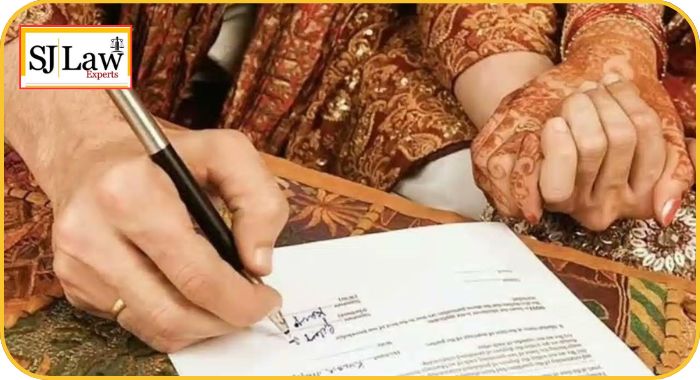
Nikah Nama is not just a religious document, it is a legally binding contract in Pakistan that protects the rights of both husband and wife. Many people assume that marriage is valid without registration, but in legal disputes, Nikah Nama is the primary proof of marriage in Pakistani courts. In this guide, SJ Law Experts explain the legal importance, registration process, and rights attached to Nikah Nama in Pakistan.
Understanding Nikah Nama in Pakistan
What Is a Nikah Nama?
The Nikah Nama is the official marriage contract between a Muslim man and woman. It is both a religious covenant and a legal document that binds the parties under Islamic Shariah and Pakistani law.
This document records key information, such as:
- Personal details of the bride and groom
- Consent of both parties
- Details of Mahr (Dower)
- Witness signatures
- Signatures of the Nikah Registrar (Nikah Khawan)
The Nikah Nama becomes legally binding once registered with the Union Council under the Muslim Family Laws Ordinance, 1961.
Legal Importance of Nikah Registration
Nikah registration is crucial because it:
- Serves as legal proof of marriage
- Protects wife’s rights (maintenance, inheritance)
- Prevents fake or denied marriages
- Required in court proceedings
👉 Without registration, proving marriage becomes difficult in legal disputes.
Legal Framework of Marriage Registration in Pakistan
The Muslim Family Laws Ordinance (MFLO) 1961 and the West Pakistan Rules under the MFLO 1961 govern marriage registration in Pakistan.
Key Legal Provisions Include:
- Section 5(1) of MFLO 1961: Every marriage solemnized under Muslim Law must be registered.
- Section 5(2): The Nikah Khawan (Nikah Registrar) is responsible for filling and submitting the Nikah Nama to the Union Council.
- Section 5(3): Failure to register the marriage can lead to a fine or imprisonment for the Nikah Registrar or the person responsible.
Thus, marriage registration is not optional — it is a legal requirement in Pakistan.
Why Marriage Registration Is Legally Important
Many people wrongly assume that an unregistered Nikah is valid if conducted religiously. While Islam recognizes a valid Nikah with proper consent and witnesses, Pakistani law requires registration to make it legally enforceable.
1. Proof of Marriage
A registered Nikah Nama acts as legal proof of marriage. It helps in matters like:
- Applying for CNIC or passport updates
- Visa or immigration purposes
- Property or inheritance rights
2. Protection of Women’s Rights: Registration ensures that women can claim maintenance (Nafaqa), dowry (Mahr), and other marital rights in case of disputes or separation.
3. Legal Recourse in Case of Divorce or Khula: A registered marriage allows women to seek divorce (Talaq) or Khula legally through the Family Court, and the court can verify the marriage record.
4. Prevention of Fraudulent Marriages: Registration prevents issues such as bigamy or underage marriages, as the Nikah Registrar is legally bound to verify the eligibility and consent of both parties.
5. Child Legitimacy and Inheritance: A registered Nikah Nama confirms the legitimacy of children born from the marriage, ensuring their legal rights to inheritance.
The Process of Marriage Registration in Pakistan
Marriage registration is a straightforward process, but it must be handled properly to avoid legal disputes later.
- Nikah Ceremony
- Conducted by a registered Nikah Khawan (Qazi).
- Both bride and groom must provide free consent.
- Two adult witnesses are mandatory.
- Filling the Nikah Nama
- The Nikah Khawan fills out the official government-issued Nikah Nama form (usually 25 columns).
- Details include personal information, Mahr, and mutual conditions.
- Signatures and Attestation
- Both parties and witnesses sign the document.
- The Nikah Khawan signs as the officiant.
- Submission to Union Council: The Nikah Registrar submits the completed form to the Union Council Office for official registration.
- Issuance of Marriage Certificate: Once registered, the Union Council issues a Computerized Marriage Certificate (NADRA Nikah Nama).
Legal Rights Stated in the Nikah Nama
The Nikah Nama isn’t just a formality — it’s a legal declaration of rights and responsibilities.
- Mahr (Dower): A mandatory right of the wife, payable by the husband. It can be prompt (immediate) or deferred.
- Delegation of Divorce Rights (Talaq-e-Tafweez): The wife can be granted the right to divorce under certain conditions, if agreed upon.
- Maintenance and Residence: The husband must provide financial support and housing to his wife.
- Restrictions on Polygamy: A husband must seek permission from the Arbitration Council before contracting another marriage.
Each of these clauses provides legal protection, especially for women. It’s crucial to fill the Nikah Nama transparently and with full understanding of its terms.
What Happens If Marriage Is Not Registered?
Failure to register Nikah can create serious legal problems:
Legal Issues:
- Difficulty proving marriage in court
- Wife may face rights issues
- Property and inheritance disputes
Social Issues:
- Lack of legal protection
- Family conflicts
Legal Rights Under Nikah Nama
Nikah Nama protects important rights:
Wife Rights:
- Maintenance (nafaqah)
- Mehr (dower)
- Protection from unlawful divorce
- Legal claim in court
Husband Rights:
- Legal recognition of marriage
- Right to enforce marital obligations
Real Case Insight (Pakistan)
At SJ Law Experts, we handled cases where individuals faced serious disputes because their Nikah Nama was not properly registered.
👉 In court:
- Lack of registration created delays
- Proof of marriage became difficult
- Legal rights were challenged
👉 This shows the importance of proper registration.
Common Mistakes to Avoid
- Not registering Nikah with Union Council
- Missing witness signatures
- Using unverified Nikah Registrar
- Losing original Nikah Nama copy
Why Nikah Nama is a Legal Contract (Important)
Nikah Nama is not only religious—it is:
- A legal contract under Pakistani law
- Enforceable in courts
- Proof of marital rights and duties
Islamic vs Legal Perspective
| Aspect | Islamic View | Pakistani Law |
| Marriage validity | Nikah is valid | Registration required for legal proof |
| Documentation | Recommended | Mandatory for protection |
| Court use | Not required | Required evidence |
Conclusion
Marriage registration in Pakistan is not just a formality, it’s a legal safeguard that ensures the rights and dignity of both partners. The Nikah Nama defines the obligations of marriage, while registration provides authenticity and legal protection in civil matters.
SJ Law Experts stand as a trusted legal partner for marriage registration, family disputes, and women’s rights in Islamabad. Whether you’re planning a Nikah, facing a registration issue, or need legal clarity, their experienced team ensures your marriage is valid, protected, and compliant with Pakistani and Islamic law.
FAQs
Is Nikah valid without registration in Pakistan?
Yes, but legal proof becomes difficult in court.
Why is Nikah Nama important?
It serves as official legal proof of marriage and protects rights.
Can wife claim rights without Nikah Nama?
It becomes difficult without proper documentation.
Who registers Nikah Nama?
A licensed Nikah Registrar submits it to the Union Council.
Legal Assistance
If you need help with marriage registration or legal documentation:
👉 SJ Law Experts provide professional legal support for:
- Nikah registration
- Family law disputes
- Marriage documentation issues