
In Pakistan, marriage is not only a social contract but also a legal relationship governed by Islamic principles and family law. Two important financial rights arising from marriage are Haq Mehr and dowry (Jahez). Unfortunately, in many cases, women are denied these lawful rights after separation or divorce. A Dowry case in Pakistan often involves recovery of unpaid Haq Mehr, withheld dowry items, or refusal by the husband or in-laws to return personal belongings. Pakistani family courts provide a clear legal mechanism to recover these rights through proper legal proceedings. This article explains how Haq Mehr and dowry can be recovered through court, the legal process involved, and the rights available under family law rights in Pakistan.
Understanding Haq Mehr and Dowry in Pakistan
What is Haq Mehr?
Haq Mehr is a mandatory financial obligation given by the husband to the wife at the time of marriage. It is a legal right under Islamic law and Pakistani family law.
It can be:
- Prompt (payable immediately)
- Deferred (payable on demand or at divorce)
Failure to pay Haq Mehr gives the wife a legal right to file a recovery case.
What is Dowry (Jahez)?
Dowry refers to gifts, money, jewelry, furniture, and household items given to the bride at the time of marriage.
Legally:
- Dowry belongs to the wife
- It cannot be taken or withheld by husband or in-laws
- It is recoverable through court if denied
Legal Basis for Dowry Case Pakistan
Pakistani family courts deal with recovery of:
- Haq Mehr
- Dowry articles
- Maintenance claims
- Property disputes related to marriage
Under family law rights, women can file a suit for recovery in Family Court under the West Pakistan Family Courts Act, 1964.
Common Issues in Dowry Case Pakistan
Many women face challenges such as:
- Non-payment of Haq Mehr: Husband refuses or delays payment after divorce or separation.
- Withholding of Dowry Items: In-laws refuse to return jewelry, furniture, or other items.
- Disputes Over Ownership: Family members claim dowry items belong to them.
- Missing Documentation: Lack of a written list of dowry items complicates recovery.
Step-by-Step Legal Process to Recover Haq Mehr and Dowry
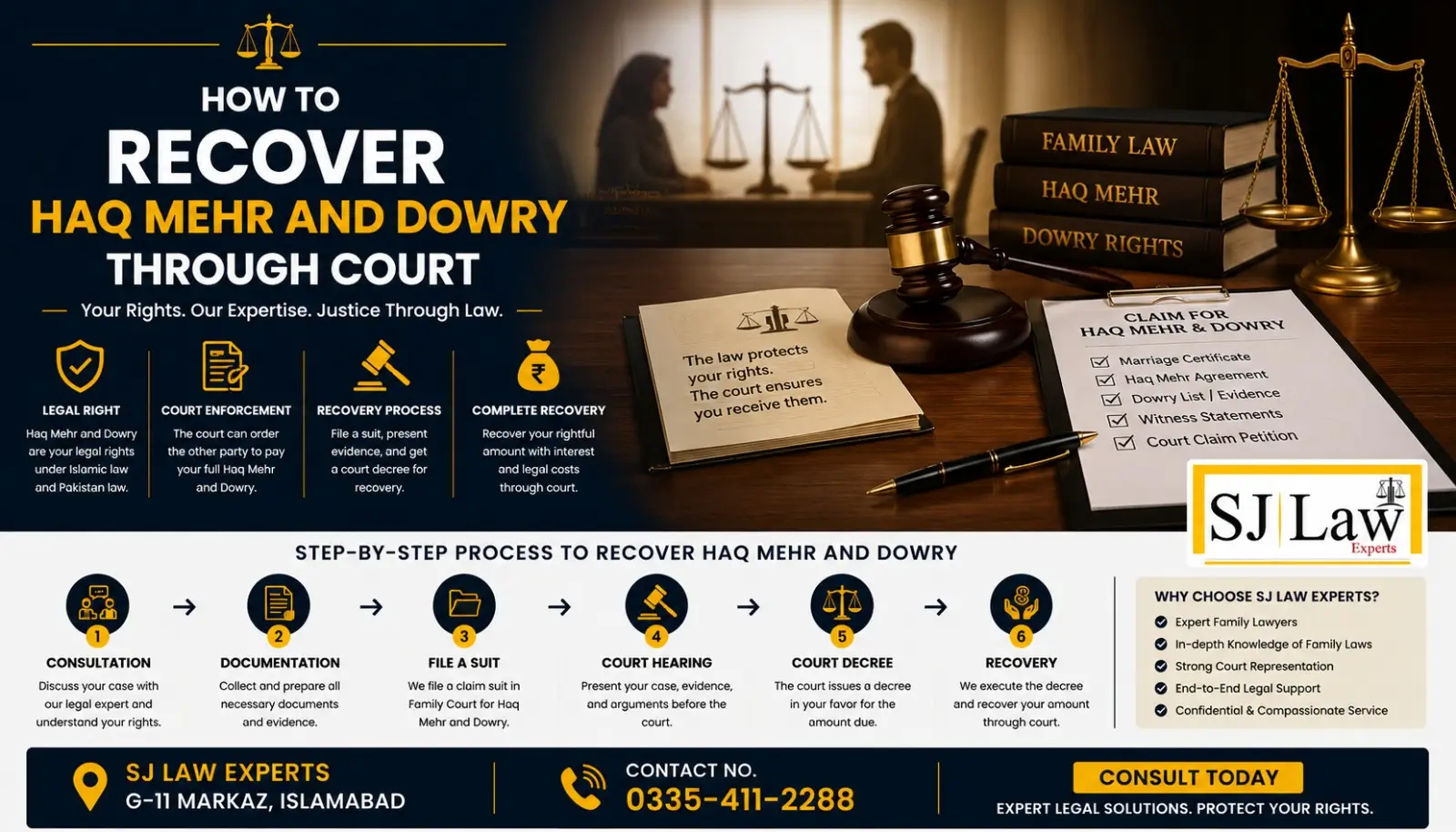
Step 1: Collect Evidence
Gather all relevant documents:
- Marriage certificate (Nikahnama)
- Written Haq Mehr agreement
- List of dowry items
- Photographs or receipts (if available)
- Witness statements
Strong evidence is essential in a Dowry case in Pakistan.
Step 2: Send Legal Notice
Before filing a case, a legal notice may be sent to the husband or in-laws demanding:
- Payment of Haq Mehr
- Return of dowry articles
This can sometimes resolve the matter without litigation.
Step 3: File Case in Family Court
If the matter is not resolved, a suit is filed in Family Court for:
- Recovery of Haq Mehr
- Return of dowry items
- Enforcement of family law rights
The court issues notices to the defendant and starts proceedings.
Step 4: Evidence and Trial
Both parties present:
- Documents
- Witnesses
- Statements
The court examines ownership and entitlement carefully.
Step 5: Court Judgment
If the claim is proven, the court may order:
- Payment of Haq Mehr
- Return of dowry items
- Monetary compensation if items are not available
Enforcement of Court Decision
If the opposing party does not comply, the court can enforce the judgment through:
- Execution petition
- Attachment of property
- Recovery orders
This ensures the rights of women are protected under law.
Importance of Family Law Rights in Pakistan
Family law rights ensure that women are legally protected in marriage-related financial matters.
These rights include:
- Right to Haq Mehr
- Right to dowry ownership
- Right to maintenance
- Right to fair legal process
Courts strongly uphold these rights to prevent exploitation.
Challenges in Dowry Case Pakistan
Common challenges include:
- Lack of written dowry list
- False denial of items
- Delay tactics in court
- Emotional pressure on claimant
- Weak documentation
Proper legal guidance helps overcome these challenges effectively.
How to Strengthen Your Case
To improve success in court:
- Keep written dowry lists at marriage time
- Preserve receipts and proof of items
- Record Haq Mehr clearly in Nikahnama
- Avoid informal agreements without documentation
- Seek legal assistance early
How SJ LAW Experts Helps
At SJ LAW Experts, we assist clients in handling Dowry case Pakistan and Haq Mehr recovery matters with a structured legal approach.
Our services include:
- Case evaluation and legal consultation
- Filing recovery suits in Family Court
- Drafting legal notices
- Evidence preparation and documentation
- Court representation
- Enforcement of judgments
We focus on protecting family law rights and ensuring lawful recovery of Haq Mehr and dowry items through proper legal channels.
Final Thoughts
Haq Mehr and dowry are legal and religious rights of women in Pakistan. Unfortunately, these rights are often ignored or disputed after marital breakdown. However, Pakistani law provides a clear legal pathway to recover them through Family Courts. A properly prepared Dowry case Pakistan can result in successful recovery of Haq Mehr and dowry items if supported by strong evidence and correct legal procedure. Understanding your family law rights and taking timely legal action is essential for protecting your financial and personal dignity.
Can Haq Mehr be recovered after divorce?
Yes, Haq Mehr is a legal right and can be recover through Family Court.
Is dowry legally returnable in Pakistan?
Yes, dowry belongs to the wife and can be recover if withheld.
How long does a dowry case take?
It depends on evidence and court workload, but varies case by case.
What if dowry items are missing?
The court may order monetary compensation instead.
Do I need a lawyer for Haq Mehr recovery?
Legal assistance is highly recommend for better case preparation and representation.
