Family disputes and marital issues can be emotionally challenging, and understanding the legal options available is essential for making informed decisions. In Pakistan, marriage dissolution can occur through different legal procedures depending on whether the husband or the wife initiates the separation. Two commonly discussed methods are divorce and khula.
Understanding the divorce vs khula Pakistan distinction is particularly important for couples living in Islamabad or elsewhere in the country. Both processes fall under family law, but they differ significantly in terms of legal authority, procedures, and rights. This guide by SJ Law Experts explains the key differences between divorce and khula in Islamabad and how each process works under Pakistani family law.
Understanding Divorce in Pakistan
In Pakistan, divorce typically refers to Talaq, which is the legal right of the husband to dissolve the marriage. Under family law, a husband may pronounce divorce according to Islamic principles and follow the legal procedure required by the government.
Legal Procedure for Divorce
The divorce process generally includes the following steps:
- Pronouncement of Talaq: The husband declares divorce according to Islamic law.
- Written Notice to Union Council: After pronouncing divorce, the husband must send a written notice to the local Union Council.
- Notice to Wife: The Union Council sends a notice to the wife and initiates reconciliation efforts.
- Reconciliation Period: A 90-day reconciliation period is provided to attempt settlement between the spouses.
- Divorce Confirmation: If reconciliation fails, the divorce becomes effective after the 90-day period.
This process ensures that divorce cases are managed under proper family law procedures and that both parties receive legal protection.
Understanding Khula in Pakistan
Khula is a legal right available to wives who wish to dissolve their marriage when the husband is unwilling to grant divorce. Unlike divorce initiated by the husband, khula requires court intervention under Pakistani family law.
Legal Procedure for Khula
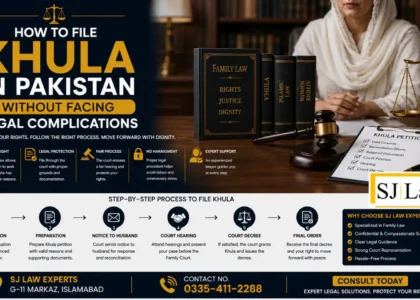
The khula process in Islamabad usually involves the following steps:
- Filing a Khula Petition: The wife files a petition in the Family Court requesting dissolution of marriage.
- Court Notice to Husband: The court sends notice to the husband and schedules hearings.
- Reconciliation Attempts: The court attempts reconciliation between the spouses.
- Court Decision: If reconciliation fails and the wife insists on separation, the court grants khula.
- Issuance of Decree: The court issues a decree dissolving the marriage, which is then sent to the Union Council for confirmation.
Khula allows women to seek relief through the legal system when continuing the marriage becomes impossible.
Divorce vs Khula Pakistan: Key Differences
Understanding the differences in divorce vs khula Pakistan helps individuals choose the correct legal option based on their circumstances.
1. Who Initiates the Process
- Divorce (Talaq): Initiated by the husband
- Khula: Initiated by the wife through the court
This is one of the most fundamental differences under family law.
2. Legal Authority
- Divorce: The husband has the authority to pronounce Talaq without initially going to court.
- Khula: The wife must file a petition in Family Court to obtain dissolution.
3. Role of the Court
- Divorce: Court involvement is limited because the process is managed through the Union Council.
- Khula: The court plays a central role in reviewing the case and issuing the decree.
4. Financial Considerations
Another important factor in divorce vs khula Pakistan cases is financial rights. In khula cases, the wife may be required to return the dower (Haq Mehr) or other marital benefits received from the husband. However, this depends on the circumstances of each case.
5. Time Duration
The time required to complete the process also differs.
- Divorce: Usually finalized after the 90-day reconciliation period.
- Khula: May take several months depending on court proceedings and case complexity.
Role of Family Courts in Islamabad
Family courts play a vital role in resolving marital disputes and ensuring fair treatment under family law.
In Islamabad, family courts handle matters such as:
- Khula petitions
- Child custody disputes
- Maintenance claims
- Guardianship cases
These courts aim to resolve disputes efficiently while protecting the rights of both spouses.
Legal Rights After Divorce or Khula
After the dissolution of marriage, several legal matters may arise under family law, including:
Child Custody: Courts determine custody based on the best interests of the child.
Maintenance: A father is generally responsible for providing financial support for children.
Dower (Haq Mehr): The treatment of dower may vary depending on whether the case involves divorce or khula. Understanding these rights is essential when evaluating divorce vs khula Pakistan options.
Importance of Legal Guidance
Marital disputes can involve complex legal and emotional issues. Professional legal assistance ensures that the process is handled properly and that the rights of both parties are protected under family law.
Experienced lawyers can help with:
- Filing divorce or khula petitions
- Preparing legal documents
- Representing clients in family courts
- Resolving disputes through legal negotiation
How SJ Law Experts Can Help
SJ Law Experts provide professional legal services for family matters in Islamabad, offering reliable guidance to individuals dealing with complex marital disputes. Our experienced legal team has extensive knowledge of divorce vs khula Pakistan cases and works in accordance with Pakistani family law to ensure that clients understand their rights and legal options.
We assist clients with divorce and khula case representation, family court litigation, child custody and maintenance matters, and legal consultations related to marital conflicts. Our goal is to provide clear legal advice, practical solutions, and strong representation so that clients can navigate family law issues with confidence and peace of mind.
Frequently Asked Questions (FAQs)
1. What is the main difference between divorce vs khula Pakistan?
In divorce vs khula Pakistan, divorce is initiated by the husband, while khula is requested by the wife through the family court.
2. Can a wife get khula without the husband’s consent?
Yes, a wife can obtain khula through the court even if the husband does not agree.
3. How long does khula take in Islamabad?
Khula cases usually take a few months depending on the court proceedings and case complexity.
4. Is court required for divorce in Pakistan?
Divorce does not initially require court involvement but must be reported to the Union Council for legal confirmation.
5. Does khula require returning Haq Mehr?
In many khula cases, the wife may be required to return the Haq Mehr, but it depends on the court’s decision.