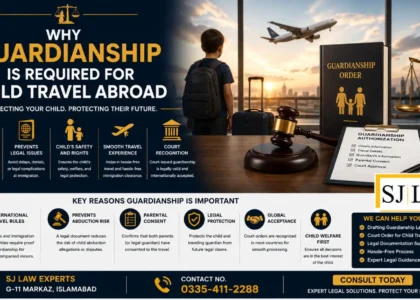

Guardianship plays a crucial role in protecting the rights, welfare, and future of minors in Pakistan. When parents are unable to care for their children, due to death, incapacity, or other circumstances, the law provides a structured mechanism to appoint a responsible guardian. The primary law governing guardianship matters in Pakistan is the Guardians and Wards Act, 1890 (GWA 1890).
1. Understanding Guardianship Under Pakistani Law
In Pakistan, guardianship is not the same as adoption. Since adoption is not legally recognized as it is in Western countries, individuals or families who wish to care for a child typically do so through legal guardianship under the GWA 1890. This process ensures that the child’s welfare, education, health, and future decisions remain under the supervision of a legally appointed guardian and the family court.
Guardianship offers legal protection to minors who require someone trustworthy to manage their personal and property interests.
2. What Is Guardianship Under the Guardians and Wards Act, 1890?
The Guardians and Wards Act, 1890 defines guardianship as the legal authority granted by the court to an individual for the care of a minor or their property.
Types of Guardians under the Act:
- Natural Guardian – Typically the father; in his absence, the mother.
- Testamentary Guardian – Appointed through a valid will.
- Court-Appointed Guardian – Appointed by family court when no natural guardian is present or capable.
The court’s primary objective is the welfare of the minor, which is the cornerstone of all guardianship decisions.
3. Who Can Be Appointed as a Guardian in Pakistan?
A guardian can be any person who meets the following legal criteria:
Eligibility Requirements:
- Must be a Muslim if the child is Muslim (in most cases)
- Must be physically and mentally fit
- Must be financially stable
- Must have a respectable moral character
- Must show genuine interest in the welfare of the child
- Should not have a criminal background or history of abuse
The court is not bound by biological relationships; instead, it evaluates who is best suited to protect the minor.
4. Legal Role and Responsibilities of a Guardian
The guardian enjoys several rights and carries major responsibilities. Their role is divided into two categories:
A. Guardian of the Person (Personal Guardian)
Responsible for:
- Physical care and wellbeing of the minor
- Education, schooling, and career decisions
- Health, medical treatment, and emergencies
- Religious upbringing
- Social development
- Ensuring the minor is raised in a safe environment
The guardian cannot change the religion of the minor and must act in the child’s best interests at all times.
B. Guardian of Property (Property Guardian)
Responsible for:
- Managing the minor’s property, inheritance, or assets
- Protecting the minor from financial exploitation
- Seeking court approval for major property transactions
- Ensuring property is used for the child’s welfare only
The guardian must maintain accounts and financial records, which can be reviewed by the court anytime.
5. Court Procedure for Guardianship Under GWA 1890
Guardianship is granted through a structured legal process to ensure transparency and child protection.
Step 1: Filing the Guardianship Petition
The applicant files a petition in the Family Court under Section 7 of the GWA 1890.
The petition includes:
- Applicant’s personal details
- Details of the minor
- Reasons for seeking guardianship
- Proof of relationship or responsibility
- Affidavit and supporting documents
Step 2: Notice to Parents or Relatives
The court issues a notice to:
- Biological parents (if alive)
- Next of kin
- Any interested party
This ensures the decision is fair and uncontested.
Step 3: Social Investigation or Guardian ad Litem Report
Courts sometimes request an inquiry by:
- Social welfare department
- Police verification
- Home inspection
This ensures the guardian’s suitability.
Step 4: Court Hearings & Evidence
The applicant presents:
- Testimony
- Evidence of financial capacity
- Proof of stable environment
- Character witnesses
The court assesses the welfare of the minor as the top priority.
Step 5: Court Order & Guardianship Certificate
If satisfied, the court issues a Guardianship Certificate, granting legal authority over:
- Person of the minor
- Property of the minor (if applicable)
This certificate is essential for:
- NADRA documentation
- Passport applications
- School admissions
- Travel permissions
6. Legal Powers Granted to a Guardian
Once appointed, a guardian has the legal power to:
- Enroll the minor in school
- Make medical decisions
- Apply for CNIC / B-Form / Passport
- Approve travel
- Manage the child’s property (with court oversight)
- Represent the minor legally
However, the guardian cannot:
- Sell immovable property without court permission
- Change the religion of the minor
- Take the child out of Pakistan for adoption purposes
- Exploit the child in any manner
7. Termination or Removal of a Guardian
A guardian may be removed or replaced if:
- They abuse their authority
- They fail to protect the child
- They become mentally unfit
- They misuse the child’s property
- They act against the welfare of the minor
The court may appoint another guardian if necessary.
8. Guardianship vs. Adoption in Pakistan
Since formal adoption is not recognized in Pakistan, guardianship serves as the closest legal alternative.
Key Differences:
| Adoption | Guardianship |
| Permanently transfers parental rights | Temporary; supervised by court |
| No ongoing court supervision | Court continues to monitor |
| Child becomes a legal heir | Child does NOT become automatic heir |
| Not allowed under Islamic law in Pakistan | Allowed under GWA 1890 |
Guardianship ensures care, safety, and upbringing without altering the child’s lineage.
9. Practical Uses of Guardianship Certificate in Pakistan
A guardianship certificate is required for:
- NADRA B-Form or CRC
- Passport issuance
- Visa processing
- School and college admissions
- Medical treatments
- Managing inherited property
It is a mandatory legal document for anyone caring for a minor not biologically their own.
10. Conclusion: Importance of Guardianship for Child Welfare
The Guardians and Wards Act, 1890 plays a vital role in protecting minors who need care, stability, and legal protection. Whether a child is orphaned, abandoned, or in need of responsible supervision, guardianship ensures that they grow in a safe, stable, and loving environment.
For legal representation, petition drafting, or guardianship applications, consulting a professional family lawyer is essential to ensure compliance with Pakistani law.