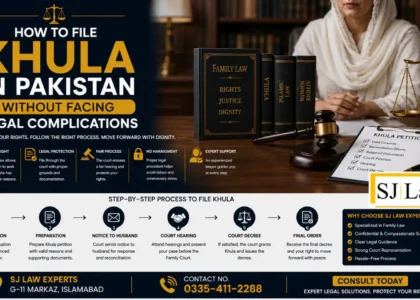

Property division after divorce is one of the most sensitive and misunderstood areas of family law in Pakistan. Unlike many Western legal systems, Pakistani law does not automatically divide property 50/50 between spouses. Instead, property rights are determined through a combination of Islamic principles, Pakistani statutes, contractual obligations, and court precedents.
This comprehensive guide explains the legal framework, rights of spouses, ownership rules, dowry issues, maintenance obligations, and the complete process of determining property division upon divorce in Pakistan.
1. How Property Division Works After Divorce in Pakistan
In Pakistan, divorce does not create an automatic right for spouses to claim each other’s property. The concept of matrimonial property (joint marital assets) is not formally recognized in Pakistani law.
Instead, property division depends on:
- Ownership title
- Contributions made by spouses
- Contractual rights under Nikah Nama
- Dowry items
- Maintenance and dower (Haq Mehr) rights
- Proof of financial contribution
- Court findings under family law
Because of these complexities, each case is evaluated individually based on evidence and law.
2. Legal Framework Governing Property Rights in Divorce
In Pakistan, several laws indirectly regulate property division after divorce:
Key Laws Relevant to Property Rights
- Muslim Family Laws Ordinance (MFLO) 1961
- Dissolution of Muslim Marriages Act 1939
- Family Courts Act 1964
- Qanun-e-Shahadat Order 1984 (Evidence Law)
- Islamic jurisprudence (Fiqh)
- Contract law (Nikah Nama provisions)
There is no single statute that orders a mandatory split of property. Courts rely on ownership and evidence.
3. Ownership Rule: Who Owns the Property?
The general rule in Pakistan is:
“Property belongs to the person in whose name it is registered.”
This applies to:
- House
- Plot
- Vehicle
- Bank accounts
- Shares
- Business assets
If a husband bought a house but registered it in his wife’s name, the law treats the wife as the legal owner, unless the husband provides evidence that it was a benami (name-lending) arrangement.
4. Property Purchased During Marriage: Joint or Separate?
Pakistani law does not treat assets acquired during marriage as joint property.
Assets are considered individual unless:
- Both spouses contributed financially
- Evidence exists of shared investment
- The asset was intended to be jointly owned
- Registered in both names
If the wife contributed financially to buying the property, she can claim her proportionate share by proving:
- Bank transfers
- Salary slips
- Transaction records
- Witnesses
- Contribution toward installments
Courts may grant reimbursement or ownership share based on proof.
5. Wife’s Property Rights After Divorce
The wife may be entitled to the following even after divorce:
A. Haq Mehr (Dower)
If not paid, the wife can claim full Haq Mehr after divorce.
The husband cannot avoid this obligation.
B. Maintenance During Iddat
The husband must provide financial maintenance during the iddat period.
C. Dowry (Jahez) Items
The wife is the legal owner of all dowry and personal belongings.
She can claim:
- Appliances
- Furniture
- Clothing
- Jewelry
- Household items
Courts generally order full return of dowry if proven.
D. Stridhan (Gifts to Wife)
Any gifts given by the husband remain the sole property of the wife.
E. Inheritance Rights
Divorce ends mutual inheritance rights unless the husband dies during the wife’s iddat.
6. Husband’s Property Rights After Divorce
A husband also has certain rights:
A. Property Registered in His Name
The wife cannot claim it unless she proves joint contribution.
B. Gifts Given by Wife
If the wife voluntarily gives something, the husband remains the owner.
C. Children’s Property
If assets belong to children, neither spouse can claim them.
D. Liability for Maintenance
The husband’s duty ends after iddat for an ex-wife, but continues for minor children.
7. Children’s Rights in Property After Divorce
Children’s property and inheritance rights are protected regardless of divorce.
They have rights to:
- Father’s property (as heirs)
- Mother’s property (as heirs)
- Maintenance until adulthood
- Education, medical care, living expenses
Parenting disputes do not affect inheritance rights.
8. Can the Wife Claim the Husband’s House After Divorce?
Only if she can prove:
- Her financial contribution
- Property was gifted to her
- Property was jointly purchased
- Property is registered in her name
Otherwise, the court cannot force division of the husband’s property.
9. Evidence Required to Claim Property Rights
To prove contribution or ownership, the following evidence is accepted:
- Bank deposit slips
- Payment receipts
- Property documents
- Witnesses
- Emails or messages proving agreement
- Installment records
- Salary contributions
Under the QSO 1984, burden of proof lies with the person claiming ownership or contribution.
10. Property Division in Khula Cases
If the wife seeks Khula, she may have to:
- Return Haq Mehr (if court orders)
- Return gifts (rare, based on case facts)
But she does not lose her rights to:
- Dowry
- Property in her name
- Children’s custody
- Maintenance for children
11. Property Division in Talaq Cases
If the husband pronounces Talaq, he must:
- Pay Haq Mehr
- Return dowry
- Provide iddat maintenance
- Provide child support
But property in his name remains his exclusive asset.
12. Property Disputes & Family Court Procedure
Step-by-Step Process:
- File a claim in family court
- Submit evidence of ownership/contribution
- Opposing party files a written reply
- Evidence and cross-examination
- Court evaluates welfare and contributions
- Court decides property or reimbursement share
13. Conclusion: Knowing Your Legal Rights Matters
Property division after divorce in Pakistan is governed by Islamic principles and domestic laws that protect the financial rights of both spouses. Since Pakistan does not follow a 50/50 property split, the outcome of each case depends on ownership documents, financial contributions, and evidence.
To safeguard your rights, consulting an experienced family lawyer is essential for proper representation in court.