Introduction
Adoption in Pakistan is often misunderstood because the country does not recognize Western-style adoption that legally replaces a child’s biological parents. Instead, Pakistan follows a guardianship-based system under the Guardians and Wards Act, 1890, which allows individuals or couples to become legal guardians of a child without altering the child’s lineage.
1. Legal Status of Adoption in Pakistan
Pakistan does not have a separate “Adoption Act.” Instead, child placement is handled through:
Guardians and Wards Act, 1890
Under this law, courts grant:
- Guardianship of the person of the minor
- Custody and decision-making rights
- Authority over the child’s education, healthcare, and welfare
However:
Adoption ≠ Guardianship
Guardianship does not:
- Create automatic inheritance rights
- Change the child’s biological lineage
- Replace the father’s name on official documents
- Sever ties with the biological family (if known)
This system aligns with Islamic principles that preserve lineage (nasab).
2. Who Can Adopt (Become a Guardian) in Pakistan?
Eligibility Criteria
Anyone who meets the following conditions can apply for guardianship:
- Must be mentally sound
- Must be financially stable
- Must have a clean criminal background
- Must provide a safe and suitable home environment
- Must be at least 21 years of age
Who Commonly Applies?
- Married couples
- Single women
- Single men (subject to stricter scrutiny, especially for girl children)
- Overseas Pakistanis (additional requirements apply)
There is no legal bar on single people applying, but courts prefer married couples when possible.
3. Legal Requirements for Adoption/Guardianship in Pakistan
Required Documentation
Parents must prepare:
- CNIC copies
- Proof of residence
- Marriage certificate (for couples)
- Income proof or employer letter
- Bank statements
- Police clearance
- Medical fitness certificate
- Character references
- Home study/social worker report
- Affidavit of guardianship commitment
Age Requirements
- Usually, the guardian must be at least 21 years older than the child.
- Some welfare organizations require the guardian to be under 50 for infants.
Religious Requirements
- For Muslim children, Muslim guardians are generally preferred.
- Non-Muslims must follow separate guidelines depending on the child’s religion.
4. Step-by-Step Court Procedure for Adoption (Guardianship)
Step 1: Child Identification from a Welfare Organization
A child must be under the care of an authorized institution, such as:
- Edhi Foundation
- Chhipa Welfare
- Child Protection Bureau
- SOS Village
- Registered orphanages
These organizations issue a “child availability” letter or supporting affidavit.
Step 2: Preparation of Petition
A Guardianship Petition is filed in the Family or Guardian Court under:
- Section 7 (Appointment of Guardian)
- Section 17 (Matters to Consider in Appointment)
The petition includes:
- Applicant’s details
- Reason for seeking guardianship
- Welfare grounds
- Child’s background
- Supporting documents
Step 3: Submission of Documents & Verification
The court may require:
- Social welfare report
- Home study report
- Verification of financial stability
- Personal interviews
The court evaluates the best interests of the child above all else.
Step 4: Court Hearings
The judge reviews:
- Welfare institution’s testimony
- Social worker’s report
- Financial checks
- Character and background verification
The guardian may be questioned about:
- Their ability to raise the child
- Their long-term plans
- Family support system
- Living arrangements
Step 5: Issuance of Guardianship Certificate
If the court is convinced, it issues:
Guardianship Certificate / Guardianship Order
This gives the guardian:
- Legal authority to care for the child
- Decision-making rights for education and healthcare
- Custody rights
This certificate forms the legal foundation for all future documentation.
Step 6: NADRA Registration of the Child
After obtaining the guardianship certificate, the guardian must:
- Register the child at NADRA
- Obtain a Child Registration Certificate (CRC)
- Update records as the child grows
- Apply for CNIC after age 18
Important:
NADRA retains the biological father’s name if known.
If unknown, NADRA issues a standard placeholder name according to government policy.
5. Legal Limitations of Adoption in Pakistan
1. No Automatic Inheritance Rights
Guardianship does not grant the child equal inheritance rights.
Guardians must create:
- A Will (Wasiyyat)
- A Gift (Hiba)
- A Trust deed
to secure the child’s future.
2. No Change in Lineage
The guardian cannot:
- Replace the biological father’s name
- Change the child’s lineage on official records
- Claim full legal parenthood
This is based on Islamic preservation of lineage.
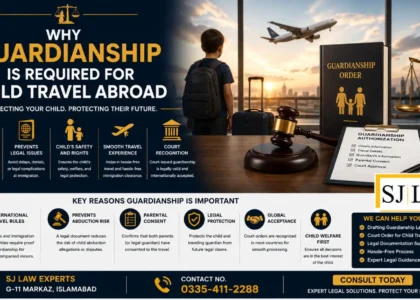
3. Travel Restrictions
For international travel:
- Guardianship certificate
- Court permission (sometimes required)
- Passport approval with supporting documents
4. Adoption Cannot Be Converted into “Full Legal Adoption”
Pakistan’s system does not allow:
- Severing ties with biological family
- Changing parentage in NADRA records
- Automatic citizenship transfer (for foreign guardians)
6. Challenges in Adoption/Guardianship in Pakistan
1. Social and Cultural Bias
Welfare institutions may prefer married couples.
2. Bureaucratic Delays
Court procedures, police checks, and welfare reports can take time.
3. NADRA Complications
Documentation and lineage issues require proper legal guidance.
4. High Scrutiny for Single Men
Placement of girl children with single men is rare and heavily regulated.
5. Legal Complexity
Guardianship laws are old and need modernization, creating procedural confusion.
Conclusion
Adoption law in Pakistan operates through a guardianship system focused on the child’s welfare and preservation of lineage. Although the process is detailed and sometimes challenging, it offers a legally recognized pathway for individuals and couples to provide a safe, nurturing home to a child.
Understanding the legal requirements, preparing proper documentation, and following the court procedure with the support of an experienced lawyer ensures a smooth and successful guardianship process.