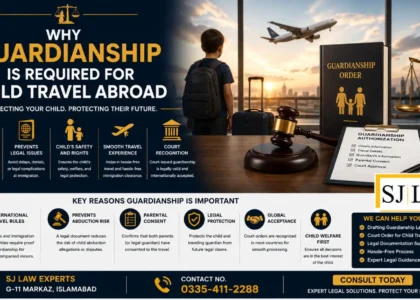

By Sadia Javed, Advocate High Court & Family Lawyer, SJ Law Experts, Islamabad
Guardianship (Wilayah or Wilayat al-Nafs) under Islamic law holds both religious and legal significance. In Pakistan, principles of guardianship are derived from the Qur’an, Sunnah, Islamic jurisprudence, and codified laws such as the Guardians and Wards Act, 1890. Guardianship determines who has the authority to make important decisions for a minor child — including matters of education, health, property, and marriage.
This article provides a comprehensive guide to guardianship in Pakistan, explaining the father’s role as the natural guardian, the mother’s guardianship rights, legal procedures, and the welfare principle applied by Pakistani courts.
1. Understanding Guardianship under Islamic Law
In Islam, guardianship (Wilayah) is considered a sacred trust rather than a privilege. It is a duty before Allah to protect and care for the minor. Guardianship is divided into two main categories:
- Guardianship of the Person (Hizanat): Custody, upbringing, and welfare of the child.
- Guardianship of Property (Wilayat al-Mal): Managing and protecting the minor’s financial and property interests.
Legal Sources of Guardianship in Pakistan
- Qur’an: Verses such as Surah An-Nisa (4:34) assign responsibility to men for family care.
- Hadith: The Prophet Muhammad (PBUH) emphasized the father’s duty toward children.
- Ijma’ (Consensus): Scholars recognize the father as the natural guardian.
- Guardians and Wards Act, 1890: Provides procedures for court-appointed guardians.
- Islamic Personal Law (Shariat) Application Act, 1962: Ensures Islamic principles govern personal matters.
2. Father as the Natural Guardian
Under Islamic law and Pakistani statutes, the father is considered the natural guardian of his minor children.
2.1 Scope of Father’s Guardianship
- Authority over education, health, and welfare decisions.
- Management of the child’s property and assets.
- Legal representation of the minor in courts.
- Acts as the Wali (marriage guardian) for a daughter.
2.2 Limitations on Father’s Guardianship
- Cannot sell or misuse a child’s property without necessity and court approval.
- Must always act in the best interest of the child.
- Guardianship may be revoked by the court if there is neglect, abuse, or incapacity.
3. Mother’s Guardianship in Pakistan
While Islamic law prioritizes the father, the mother can become a guardian in specific circumstances.
3.1 Situations When the Mother Becomes Guardian
- Upon the death of the father.
- If the father is incapacitated (mental illness, imprisonment, absence).
- When appointed by the Guardian Court under the Act of 1890.
3.2 Mother’s Rights as Guardian
- Custody (Hizanat): Mother has priority custody of boys until age 7 and girls until puberty (Hanafi law), subject to the child’s welfare.
- Day-to-day care: She is usually the primary caregiver.
- Limited property authority: May manage property if appointed by the court.
3.3 Limitations
- Her guardianship remains secondary to the father’s unless the court rules otherwise.
- Remarriage to a non-relative may affect her custody rights in some schools of thought.
4. Other Guardians in Islamic Law
If both parents are unavailable, guardianship may pass to other male relatives, in order of priority:
- Paternal grandfather
- Full brother
- Paternal uncle
- Other male agnates (Asabah)
5. Guardianship Procedure in Pakistan
Guardianship petitions are filed before the Guardian Court under the Guardians and Wards Act, 1890.
5.1 Requirements for Filing
- Petition: Filed by eligible person (father, mother, or relative).
- Jurisdiction: Court where the child resides.
- Documents Needed:
- CNIC copies of petitioner and witnesses
- Child’s birth certificate
- Proof of relationship (Nikahnama, Family Registration Certificate)
- Death certificate/incapacity proof of father (if applicable)
- CNIC copies of petitioner and witnesses
5.2 Court Process
- Petition submission
- Notice to respondents
- Evidence and witness stage
- Welfare inquiry by court
- Court decree and issuance of Guardianship Certificate
6. Welfare Principle in Guardianship
Pakistani courts emphasize the “welfare of the minor” as the guiding principle, even over strict legal rules. Factors include:
- Emotional bonding
- Educational stability
- Physical and mental health
- Religious upbringing
7. Guardianship of Property
A guardian managing property must:
- Keep financial accounts for the minor.
- Seek court approval for sale or transfer of assets.
- Use funds only for the child’s welfare.
8. Termination of Guardianship
Guardianship ends when:
- The child reaches majority (18 years, or 21 in property matters).
- The guardian dies.
- The court removes the guardian for misconduct or incapacity.
9. Practical Advice for Parents & Relatives
- Always secure court orders rather than informal arrangements.
- Keep legal records such as birth certificates, custody orders, and property papers.
- Consult a family lawyer for proper guardianship and custody proceedings.
- Prioritize child welfare in all decisions.
10. Role of SJ Law Experts in Guardianship Matters
At SJ Law Experts, Islamabad, we provide:
- Legal advice under Islamic and statutory law
- Drafting & filing of guardianship/custody petitions
- Representation in Guardian Courts across Pakistan
- Property guardianship & estate management for minors
- Mediation & dispute resolution between family members
📞 For Appointments:
- Phone: +92-335-4112288
- Address: Office No. 1, First Floor, Al Anayat Mall, G-11 Markaz, Islamabad
- 🌐 Website: SJ Law Experts – Guardianship Services