
Introduction to Child Visitation Rights in Pakistan
In Pakistan, child visitation rights form a critical part of family law, ensuring that a child maintains a meaningful relationship with both parents after separation or divorce. As legal professionals focused on child welfare and family stability, we recognize that maintaining parental bonds is essential for a child’s emotional growth, security, and identity. The legal framework governing these rights aims to balance parental interests with the paramount principle of the child’s best interests.
Legal Basis of Child Visitation Rights in Pakistan
Guardians and Wards Act, 1890
Under the Guardians and Wards Act, 1890, the courts in Pakistan determine custody and visitation matters. While custody usually rests with one parent—often the mother for younger children, the non-custodial parent is generally granted visitation rights unless such visitation is proven harmful to the child.
Family Courts Act, 1964
The Family Courts Act, 1964 empowers family courts to hear cases related to guardianship, custody, and visitation. The law encourages swift resolution, recognizing the emotional toll prolonged litigation has on children.
Islamic Principles in Custody and Visitation
Islamic jurisprudence plays an influential role in shaping family law. Courts commonly consider principles of Hizanat (custody) and Wilayat (guardianship), ensuring that both parents maintain their responsibilities regarding upbringing, guidance, and emotional support. Visitation rights are treated as an extension of this parental obligation.
Determining Factors for Granting Visitation Rights
Best Interests of the Child
The cornerstone of all visitation decisions is the child’s welfare. Courts evaluate numerous factors, including:
- Emotional attachment with each parent
- Age and developmental needs
- Schooling and routine stability
- Parental conduct and living conditions
- Safety, comfort, and well-being during visits
The courts strive to ensure that visitation strengthens the child’s emotional resilience rather than disrupts it.
Parent–Child Relationship
A healthy, established bond with the non-custodial parent strengthens the case for regular visitation. Judges often encourage structured, consistent interaction, considering that positive relationships reduce trauma caused by family separation.
Parental Conduct and Lifestyle
Courts assess behavior such as past abuse, substance misuse, or violence. If allegations arise, supervised visitation may be ordered until the environment is deemed safe.
Types of Visitation Rights in Pakistan
Supervised Visitation
When concerns about child safety exist, courts may impose supervised visitation. These visits often occur at designated court visitation centers, under professional oversight.
Unsupervised Visitation
For cases without safety risks, courts grant unsupervised visits. These may include:
- Weekly or biweekly visits
- Overnight stays depending on age and circumstances
- Extended holiday visits
Virtual Visitation
As technology evolves, courts increasingly recognize online visitation via video calls. This method supports continuous bonding, especially when parents live far apart.
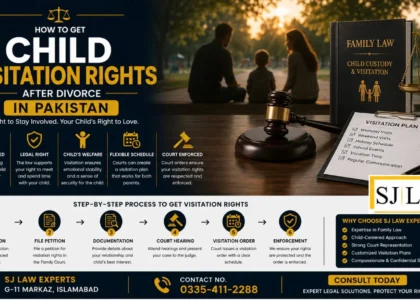
Court Procedures for Visitation Applications
Filing the Petition
A non-custodial parent seeking visitation must file a petition under the Guardians and Wards Act. The application should include:
- Relationship details
- Reasons for seeking visitation
- Preferred days and timings
- Proof of good character and stability
Court Hearings and Evidence Evaluation
Family courts typically call both parties to present evidence, including witness statements, school reports, or psychological evaluations in complex cases.
Interim Visitation Orders
Because custody disputes may take months, courts often grant interim visitation orders to maintain parent-child contact during proceedings.
Enforcement of Visitation Orders in Pakistan
Role of Family Courts
If a custodial parent denies court-ordered visitation, the aggrieved parent may file an execution petition. Family courts have authority to:
- Enforce visitation schedules
- Issue warnings or fines
- Order police assistance in serious violations
Legal Consequences of Violating Visitation Orders
Repeated refusal to comply can result in:
- Contempt of court proceedings
- Modification of custody arrangements
- Enhanced visitation rights for the non-custodial parent
Courts prioritize preventing parental alienation, recognizing its deep psychological impact on children.
Rights and Responsibilities of Non-Custodial Parents
Right to Meaningful Contact
Non-custodial parents hold the right to maintain consistent and meaningful involvement in their child’s life. This includes participation in:
- School activities
- Religious upbringing
- Medical decisions (where appropriate)
Obligation to Respect Custody Arrangements
Parents must strictly follow visitation schedules and return the child at the agreed time. Courts view compliance as a sign of responsible parenting.
Child Visitation Rights in Cases of Overseas Parents
When a parent resides abroad, specialized arrangements are made, such as:
- Holiday-based extended visits
- Virtual weekly calls
- Conditional visitation during travel to Pakistan
Courts evaluate the feasibility of international travel and the potential disruption to the child’s routine.
Mediation and Alternative Dispute Resolution
Family courts often encourage mediation to help parents reach mutually beneficial agreements. Mediation may reduce hostility, saving time and emotional strain. Agreements formed voluntarily tend to be more sustainable and child-centered.
When Courts Modify Existing Visitation Orders
Changes in circumstances may warrant revisiting an existing visitation plan. Courts typically consider modification requests when:
- A parent relocates
- The child’s schooling schedule changes
- Safety concerns emerge
- The child expresses mature preferences
These modifications aim to uphold the child’s best interests while ensuring both parents remain involved.
Importance of Maintaining Healthy Post-Divorce Parenting
A well-structured visitation schedule helps children:
- Preserve emotional stability
- Feel supported by both parents
- Maintain a sense of identity
- Adapt better to family transitions
Parents who encourage positive interactions contribute significantly to their child’s mental well-being.
Conclusion
A strong legal framework guides child visitation rights in Pakistan, ensuring that each decision protects the child’s well-being above all else. Whether through supervised visits, unsupervised schedules, or virtual interaction, the law emphasizes preserving the vital bond between parent and child. By understanding the legal processes and respecting court orders, families can navigate these challenging transitions with dignity and compassion.