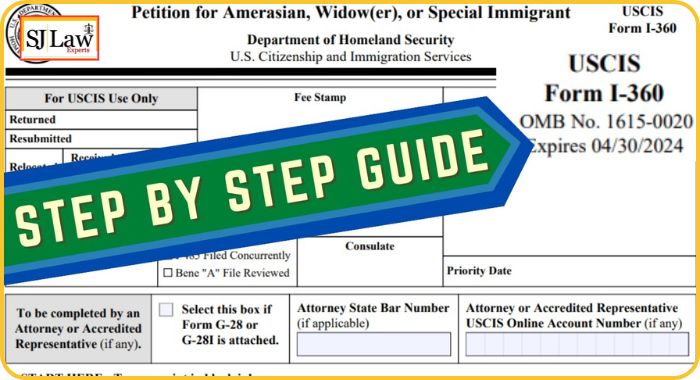
For many immigrants, navigating the U.S. immigration system can be complex and overwhelming. One important pathway for certain categories of immigrants is the I-360 petition, also known as the Special Immigrant Petition. Whether you are a religious worker, Afghan or Iraqi national, or part of another eligible category, understanding the USCIS special immigrant petition process is crucial to ensure your application is successful.
SJ Law Experts provide a detailed guide on filing an I-360 petition from Pakistan, including eligibility, required documentation, timelines, and common pitfalls.
What Is the I-360 Special Immigrant Petition?
The I-360 petition is a form filed with the United States Citizenship and Immigration Services (USCIS) that allows certain immigrants to apply for lawful permanent residence in the U.S. under special immigrant categories.
Key points about the USCIS special immigrant petition:
- It is filed using Form I-360
- Establishes eligibility for a specific special immigrant category
- Serves as the first step toward applying for a green card for eligible immigrants
Who Can File an I-360 Petition?
Several categories of immigrants may qualify to file an I-360 petition:
1. Religious Workers
- Ministers and religious professionals
- Non-minister religious workers employed by a nonprofit religious organization
2. Certain Special Immigrant Juveniles
- Minors who have been abused, abandoned, or neglected
3. Afghan or Iraqi Nationals
- Individuals who worked with the U.S. government abroad
- Eligible for special immigrant status under the Afghan or Iraqi program
4. Other Special Categories
- Certain international broadcasters, Panama Canal Zone employees, and more
Eligibility depends on your category, age, employment, and other requirements.
Eligibility Requirements for Religious Workers
If filing as a religious worker, the applicant must:
- Be a member of a religious denomination for at least two years
- Seek to work in the U.S. in a full-time religious vocation or occupation
- Be employed by a nonprofit religious organization
- Intend to continue working in that role in the U.S.
Supporting evidence such as letters from the religious organization and proof of membership is critical.
How to File an I-360 Petition from Pakistan
Filing an I-360 petition involves several steps:
Step 1: Prepare Form I-360
- Complete the form accurately, including personal information, category, and supporting evidence
- Ensure all required documents are attached
Step 2: Gather Supporting Documents
- Proof of employment or affiliation (e.g., religious organization letters)
- Identity documents (passport, birth certificate)
- Evidence of qualifications (e.g., ministerial credentials)
Step 3: Submit to USCIS
- File the petition online or via mail to the designated USCIS service center
- Pay applicable filing fees
Step 4: Receive USCIS Receipt Notice
- USCIS issues Form I-797 receipt notice confirming petition submission
- Tracking number provided to monitor case status
Processing Times for I-360 Petition
Processing times vary depending on the category:
- Religious workers: approximately 6–8 months
- Afghan or Iraqi nationals: may vary due to special program timelines
- Special immigrant juveniles: typically 6–9 months
Delays may occur due to additional evidence requests (RFE) or background checks.
What Happens After I-360 Approval
Once your I-360 petition is approved:
- You may apply for adjustment of status if in the U.S.
- If outside the U.S. (e.g., Pakistan), you undergo consular processing at the U.S. Embassy
- Complete visa interview and medical examination
- Receive immigrant visa or green card
Consular Processing for Applicants in Pakistan
For applicants in Pakistan:
- Approved I-360 petitions are forwarded to the National Visa Center (NVC)
- The NVC schedules an interview in the U.S. Embassy in Islamabad
- Submit required documents including civil documents, police clearance, and visa forms
- Attend the interview for final approval
Common Challenges in Filing I-360 Petition
Some common pitfalls include:
- Incomplete or inconsistent documentation
- Missing proof of employment or membership for religious workers
- Failure to meet eligibility requirements
- Not responding promptly to USCIS Requests for Evidence (RFE)
SJ Law Experts emphasize that attention to detail is crucial for approval.
Tips for Successful I-360 Filing from Pakistan
- Ensure eligibility: Verify your category and qualifications before filing
- Prepare complete documents: Gather all evidence, letters, and certificates
- Keep copies: Always maintain copies of submitted forms and attachments
- Respond to RFEs quickly: Timely responses prevent delays or denials
- Seek legal guidance: Professionals help avoid common mistakes and improve success chances
Difference Between I-360 Petition and Other Immigration Petitions
| Feature | I-360 Petition | Other USCIS Petitions (e.g., I-130) |
| Purpose | Special immigrant categories | Family or employment-based immigration |
| Categories | Religious workers, Afghan/Iraqi nationals, special immigrant juveniles | Spouses, children, employment-based applicants |
| Processing | May include consular processing | Typically follows immigrant visa or adjustment of status |
| Supporting Evidence | Highly detailed proof of qualifications or service | Standard proof of relationship or employment |
Understanding this difference helps applicants file correctly and avoid rejection.
How SJ Law Experts Can Assist
SJ Law Experts provide comprehensive assistance with USCIS special immigrant petition filing from Pakistan:
- Evaluate eligibility for I-360 categories
- Prepare and review complete petition packages
- Assist with consular processing documentation
- Represent applicants in case of USCIS Requests for Evidence
- Provide step-by-step guidance to improve approval chances
Professional guidance reduces errors and ensures smoother processing.
Conclusion
Filing an I-360 petition from Pakistan is a critical step for eligible immigrants seeking U.S. permanent residence under special immigrant categories. Understanding the requirements, preparing accurate documentation, and responding promptly to USCIS are key to success. Whether you are a religious worker, Afghan/Iraqi national, or part of another qualifying category, SJ Law Experts can guide you through the process and ensure your USCIS special immigrant petition is properly filed and handled.
With careful planning, legal guidance, and timely submission, your path to permanent residence in the U.S. can be smooth and successful.
FAQs
1. What is an I-360 petition?
It is a USCIS special immigrant petition for eligible categories like religious workers, Afghan/Iraqi nationals, and special immigrant juveniles.
2. Can I file an I-360 petition from Pakistan?
Yes, you can file from Pakistan and undergo consular processing if approved.
3. How long does I-360 processing take?
Processing times vary by category, usually 6–9 months.
4. What is the difference between I-360 petition and I-130?
I-360 is for special immigrant categories, while I-130 is for family-based immigration.
5. How can legal experts help with I-360 petitions?
They assist with eligibility evaluation, petition preparation, RFE responses, and consular processing guidance.