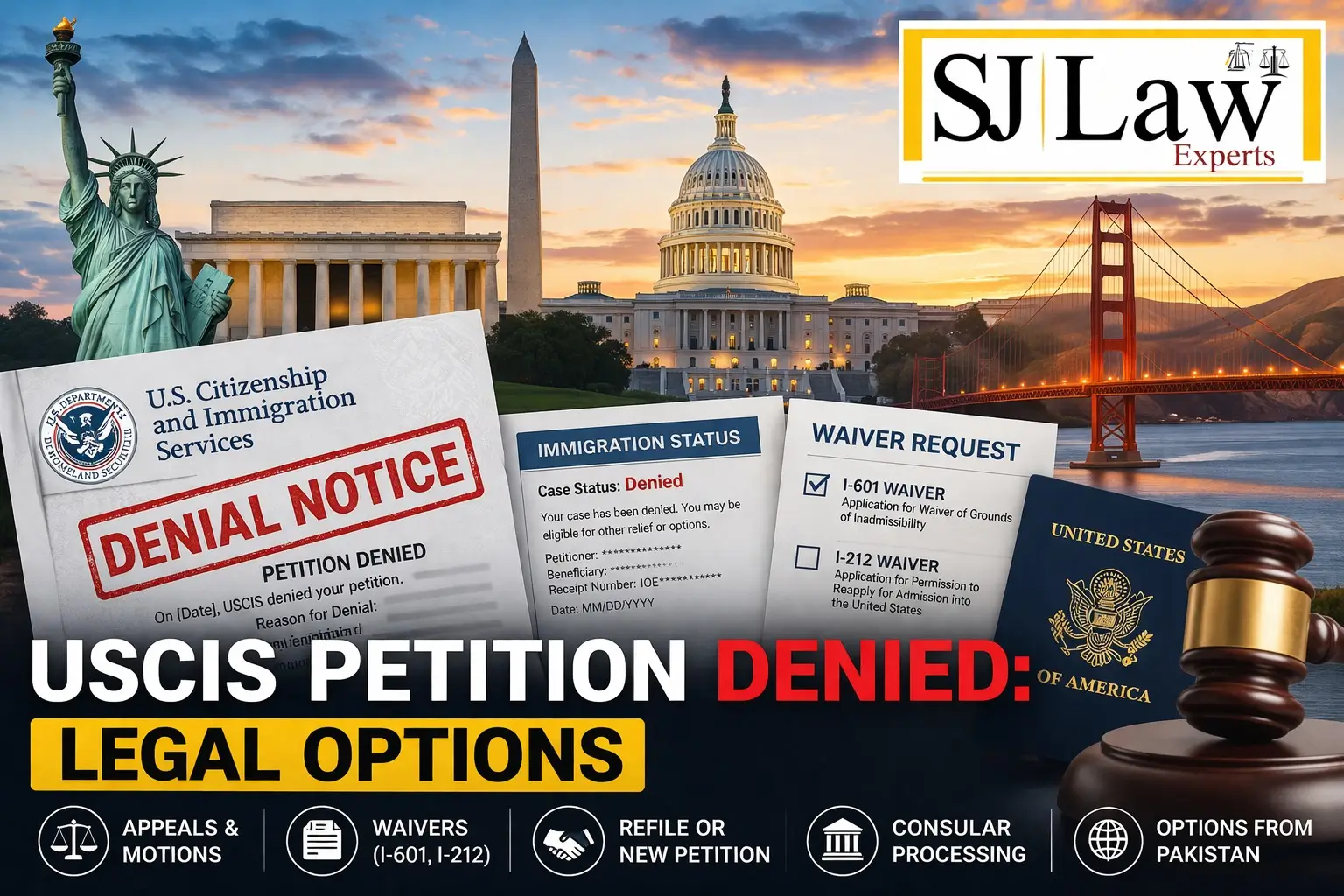
When a USCIS Petition Denied notice arrives, it can feel like a locked door suddenly slammed shut after months or even years of waiting. Families in Pakistan applying for spouse visas, family petitions, employment petitions, waivers, fiancé visas, or immigration benefits often invest emotional energy, legal fees, and long-term plans into their USCIS case. A denial letter from the U.S. Citizenship and Immigration Services can create confusion, panic, and uncertainty about the future. The good news is that a denial does not always mean the end of your immigration journey.
Recent USCIS guidance confirms that applicants and petitioners may still have important legal remedies available, including appeals, motions to reopen, motions to reconsider, and refiling options through Form I-290B. USCIS generally allows 30 days to challenge many denials, or 33 days if the decision was mailed. For applicants in Pakistan, timing becomes even more critical because international mailing delays, document preparation, and embassy-related complications can affect the strategy.
Missing Documentation and Evidence Issues
One of the most common reasons behind a USCIS Petition Denied decision is weak supporting evidence. Family-based petitions from Pakistan frequently face scrutiny regarding marriage authenticity, financial sponsorship, relationship timelines, and supporting civil documents. If USCIS officers believe the documents fail to establish eligibility, they may deny the petition outright. Pakistani applicants sometimes encounter additional complications involving document verification. Birth certificates, NADRA documents, police certificates, translations, and educational records must meet USCIS standards. Even a small inconsistency between spellings, dates, or addresses can raise red flags. Think of USCIS officers as auditors examining every detail under a microscope. A single mismatch can trigger suspicion about the entire application.
Misrepresentation and Inconsistencies
Another major reason for denial involves allegations of misrepresentation or contradictory information. USCIS compares information across forms, visa applications, interviews, and prior immigration filings. If inconsistencies appear, the agency may question credibility.
Suppose an applicant previously applied for a tourist visa and stated they were single, but later submits a marriage-based petition claiming they were already married at that time. USCIS may interpret the contradiction as intentional misrepresentation. Even innocent mistakes can create serious legal problems if not addressed properly. According to USCIS appeal guidance, motions to reconsider generally argue that USCIS incorrectly applied immigration law or policy to the facts already in the record. This becomes especially important when the denial stems from legal interpretation rather than missing evidence.
What to Do Immediately After a USCIS Petition Denial
Receiving a denial notice can feel emotionally overwhelming, especially for families separated between Pakistan and the United States. Still, immediate action matters. Immigration law works on strict deadlines, and every day counts after the denial is issued.
Review the Denial Notice Carefully
The denial notice acts like a legal roadmap. It explains the exact reasons USCIS denied the petition and outlines whether the decision can be appealed or challenged through a motion. Many people skim the denial notice emotionally without analyzing the legal reasoning. That mistake can cost valuable time and opportunities.
A proper legal review involves identifying:
| Important Review Area | Why It Matters |
| Legal basis of denial | Determines appeal strategy |
| Missing evidence | Helps prepare stronger filing |
| Filing deadline | Avoids losing legal rights |
| Appeal eligibility | Confirms whether AAO review is available |
| USCIS factual errors | Supports reconsideration arguments |
USCIS confirms that appeals and motions are generally filed using Form I-290B. The denial notice will normally indicate whether the case qualifies for an appeal before the Administrative Appeals Office (AAO) or only allows a motion.
Identify Appeal Deadlines
Deadlines are extremely strict in immigration cases. USCIS states that appeals and motions usually must be filed within 30 calendar days, or 33 days if the decision was mailed. Missing the deadline can eliminate important legal remedies. Applicants in Pakistan face extra logistical challenges because international courier delays can consume valuable preparation time. Gathering supporting documents from Pakistan, preparing legal briefs, obtaining translations, and coordinating with U.S.-based sponsors may require immediate legal action. Many families waste precious weeks discussing the denial emotionally without consulting an immigration lawyer. By the time they seek legal advice, the filing deadline may already be close. Immigration law is like a moving train. Once the deadline passes, catching up becomes much harder.
USCIS Petition Denied Pakistan Legal Options
After a denial, petitioners generally have three primary legal pathways: appeal, motion to reopen, or refiling. Choosing the correct strategy depends entirely on the reason for denial.
Filing an Appeal with the AAO
An appeal asks a higher USCIS authority to review the denial decision. Most appeals go to the Administrative Appeals Office (AAO). USCIS explains that the AAO reviews whether the original officer applied immigration law correctly.
Appeals may work well when:
- USCIS misunderstood the law
- The officer ignored submitted evidence
- The denial misapplied immigration regulations
- The case contains strong legal arguments
Appeals are not simply emotional requests asking USCIS to “please reconsider.” They require detailed legal analysis supported by immigration statutes, regulations, policy manuals, and evidence already contained in the record. Recent community discussions show that AAO appeals can take several months before a final decision arrives. For families waiting abroad in Pakistan, this timeline can feel painfully long. Still, a successful appeal may revive the original petition without starting from scratch.
Motion to Reopen
A motion to reopen focuses on presenting new evidence or facts that were unavailable during the original filing. USCIS states that motions to reopen must include documentary evidence establishing new facts.
For Pakistani applicants, motions to reopen commonly involve:
- Newly available civil documents
- Corrected translations
- Additional relationship evidence
- Employer clarification letters
- Financial documentation
- Corrected filing deficiencies
Imagine the original petition as an incomplete puzzle. A motion to reopen provides the missing pieces USCIS claims were absent before. This strategy works best when the denial resulted from evidentiary gaps rather than legal errors.
Motion to Reconsider
A motion to reconsider argues that USCIS incorrectly interpreted the law or policy using the evidence already available in the case. Unlike motions to reopen, reconsideration motions generally cannot rely on new evidence.
This option may apply when:
- USCIS misread immigration regulations
- Officers ignored legal precedent
- The denial contained factual inaccuracies
- USCIS improperly evaluated submitted evidence
Strong legal writing becomes critical here. Immigration attorneys often cite statutes, USCIS policy guidance, federal regulations, and administrative decisions to challenge the denial.
USCIS Petition Appeal Motion Reopen Pakistan
The legal procedures after denial may sound intimidating, but understanding the process reduces anxiety significantly.
Understanding Form I-290B
Form I-290B is the primary form used for appeals, motions to reopen, and motions to reconsider. USCIS confirms that most petitioners use this form to challenge unfavorable decisions. The form itself may appear short, but the legal package behind it is often extensive. A strong filing usually includes:
- Detailed legal brief
- Supporting exhibits
- Affidavits
- Corrected documentation
- Timeline explanations
- Legal citations
Community experiences shared online show that well-prepared I-290B filings can sometimes reopen denied cases successfully within weeks or months. Poorly prepared filings, however, often lead to repeated denials.
Required Supporting Evidence
Evidence is the backbone of every immigration case. USCIS officers are trained to evaluate credibility, consistency, and legal eligibility through documents. A weak evidentiary package is like trying to build a house on sand.
For family-based cases from Pakistan, supporting evidence may include:
| Evidence Type | Examples |
| Relationship proof | Photos, chats, travel records |
| Financial evidence | Joint accounts, remittances |
| Civil documents | NADRA certificates, translations |
| Affidavits | Family and witness statements |
| Communication logs | WhatsApp, email, call records |
Employment-based petitions may require employer contracts, tax records, professional evaluations, and business evidence.
USCIS Petition Refile or Appeal from Pakistan
One of the biggest strategic questions after denial is whether to refile or appeal. The answer depends entirely on the denial reason.
When Refiling Makes More Sense
Sometimes refiling is faster and stronger than appealing. If the original petition contained major evidentiary problems, incomplete forms, or avoidable mistakes, starting fresh may be the smarter route.
Refiling may work better when:
- Critical evidence was missing
- The petitioner became newly eligible
- Financial sponsorship issues were corrected
- Marriage evidence has become stronger over time
- Prior filing errors damaged the case
Think of refiling as rebuilding a damaged structure from the ground up instead of trying to repair a collapsing wall. In some situations, a clean, carefully prepared petition has a higher chance of approval than a lengthy appeal battle.
When an Appeal Is the Better Option
Appeals become stronger when USCIS made a legal mistake rather than an evidentiary finding. If the petition was actually complete and the denial resulted from incorrect interpretation of immigration law, an appeal may preserve the original filing date and challenge the agency directly. Appeals may also become strategically important in employment-based immigration cases where priority dates matter significantly. Losing an earlier priority date through refiling could create long-term immigration consequences.
Common USCIS Petitions Denied from Pakistan
Certain immigration categories from Pakistan tend to face higher scrutiny due to fraud concerns, documentation inconsistencies, or complex eligibility rules.
Family-Based Petitions
Marriage petitions, fiancé petitions, and family sponsorship cases frequently face denials involving relationship authenticity. USCIS officers often examine:
- Wedding timelines
- Communication history
- Age differences
- Prior marriages
- Cultural inconsistencies
- Financial sponsorship
Pakistani couples separated by geography often struggle to provide traditional joint financial evidence because they live in different countries. Legal strategy becomes essential in presenting alternative relationship proof.
Employment and Investor Petitions
Employment petitions may face denial due to specialty occupation disputes, employer credibility concerns, or financial documentation issues. Investor petitions often encounter scrutiny regarding lawful sources of funds. Pakistani business records, banking history, and tax documentation may require extensive explanation and translation. USCIS officers unfamiliar with local systems sometimes misunderstand the evidence unless it is clearly organized.
Role of a US Immigration Lawyer Pakistan USCIS Denial Help
Immigration denials are not DIY territory in complex cases. A professional immigration lawyer evaluates not just the denial notice, but also the entire procedural history behind the case.
Strategic Legal Review
An experienced immigration attorney identifies whether the denial stems from factual issues, legal interpretation, procedural error, or insufficient evidence. That distinction shapes the entire strategy moving forward.
A proper legal review often includes:
- Reviewing USCIS officer notes
- Examining RFEs and NOIDs
- Analyzing inconsistencies
- Identifying overlooked evidence
- Determining strongest remedy
Many applicants wrongly believe all denials should be appealed. In reality, lawyers sometimes recommend refiling because the underlying case weaknesses cannot realistically be fixed through appeal.
Avoiding Repeat Denials
A second denial can create even bigger immigration complications. Repeated filings containing the same weaknesses may damage credibility and raise concerns about misrepresentation. An immigration lawyer helps ensure that the next filing addresses every USCIS concern directly. Think of legal representation as using a GPS during a storm. Without proper direction, applicants can easily take the wrong turn and lose valuable time.
Processing Times and Practical Challenges for Pakistani Applicants
Pakistani applicants face unique logistical hurdles during post-denial proceedings. International courier delays, embassy scheduling issues, document verification, and communication barriers can complicate already stressful situations. Community discussions online show that AAO appeals and motions sometimes remain pending for several months before final action occurs. While some motions reopen cases relatively quickly, others move slowly depending on workload and case complexity. Applicants should also understand an important USCIS rule: filing an appeal or motion does not automatically stop immigration consequences or extend departure deadlines. This becomes especially critical for applicants already present in the United States.
Strong organization helps significantly during this phase. Families should maintain copies of:
- Every USCIS filing
- Courier receipts
- Communication records
- Translations
- RFEs and NOIDs
- Prior visa applications
Immigration litigation resembles chess more than checkers. Every move affects future possibilities.
Conclusion
A USCIS Petition Denied decision can feel devastating, especially for Pakistani families waiting for reunification, employment opportunities, or immigration approval in the United States. Still, a denial does not automatically end the process. USCIS regulations provide several legal remedies, including appeals, motions to reopen, motions to reconsider, and refiling options depending on the circumstances of the case. The most important step after denial is acting quickly and strategically. Petitioners should carefully analyze the denial notice, identify filing deadlines, gather supporting evidence, and seek professional immigration guidance before choosing a legal path. Appeals work best for legal errors, motions to reopen help introduce new evidence, and refiling may provide a fresh opportunity when the original petition was fundamentally weak.
What should I do immediately after a USCIS petition denial in Pakistan?
You should first review the denial notice carefully, identify the legal reason for denial, and check the deadline for appeal or motion filing. Most USCIS appeals and motions must be filed within 30 days or 33 days if mailed.
Can I appeal a USCIS denial from Pakistan?
Yes, many USCIS denials can be appealed through the Administrative Appeals Office using Form I-290B, depending on the immigration category and denial type.
What is the difference between a motion to reopen and a motion to reconsider?
A motion to reopen introduces new evidence or facts, while a motion to reconsider argues that USCIS made a legal or policy error using the existing evidence already in the record.
Is it better to refile or appeal a denied USCIS petition?
It depends on the denial reason. Refiling may work better for weak evidence cases, while appeals are stronger when USCIS misapplied immigration law or ignored valid evidence.
How long does a USCIS appeal take after denial?
Processing times vary widely. Community reports show some AAO appeals may take several months before resolution depending on case type and workload.